
Journal of Liberal Arts and Interdisciplinary Sciences

1Department of Liberal Studies and Political Science, JECRC University, Jaipur, Rajasthan, India

Creative Commons Non Commercial CC BY-NC: This article is distributed under the terms of the Creative Commons Attribution-NonCommercial 4.0 License (http://www.creativecommons.org/licenses/by-nc/4.0/) which permits non-Commercial use, reproduction and distribution of the work without further permission provided the original work is attributed.
This article reconceptualizes genocide through the lens of forced displacement and legal erasure, discussing how exile and statelessness are not simply consequences of mass atrocity, but can be seen as ongoing forms of genocidal intent. By analyzing the Rwandan and Sudanese genocides through secondary analysis, the article demonstrates how administrative containment, racial identity erasure, and legal exclusion constitute structured, organized forms of violence that take place even after the immediate mass killing has ceased. By employing sociologist Orlando Patterson’s construct of social death, the article demonstrates how the displacement of the population impacts the progressive loss of their political and legal personhood. They are not only expelled physically but also wholly erased bureaucratically and symbolically by way of prolonged disconnection from citizenship, rights, and acknowledgment. A comparative table that maps the indicators of “genocidal continuation” across both studies found somewhat similar patterns for encampment, identity erasure, and state exclusion. These findings highlight the importance of temporally and spatially reconceptualizing genocide beyond event-based frameworks to include these prolonged harms and injustices created through law, policy, and inaction on behalf of the international community.
Genocide, statelessness, forced migration, social death, Rwanda, Darfur
Introduction
Traditional legal analyses of genocide have a tendency to place its terminus at the end of mass violence or the official announcement of peace. Yet for most survivors, what follows is not justice or healing, but the persistence of violence in less egregious, structural forms. History contends that forced migration, more specifically, exile, statelessness, and prolonged displacement, is not merely collateral damage to genocide but an intrinsic part of its continuing logic. Placing genocide as a process rather than an event makes it easier to have an honest conversation with the long-term harms faced by displaced persons. In this argument, displacement is not the consequence of genocide, but one of its forms.
Focusing on mechanisms that include statelessness, spatial exclusion, and legal abandonment, this study brings to the forefront how genocidal intent is transformed into administrative and geographic modes of erasure (Hovil, 2016; Mamdani, 2009). These mechanisms are also beyond the reach of international law, which seeks to rigidly dichotomize acts of mass violence from the bureaucratic and geopolitical processes of migration. However, as survivors themselves affirm, such legal borders seldom meet lived reality. The genocide’s long tail runs to refugee camps, borderlands, and national rolls—sites where identity is erased or instrumentalized, and return is coded as a risk rather than a right (UNHCR, 2023).
This study essentially engages the post-genocide geography of Rwanda and Sudan in order to describe how displacement turns into a site of erasure instead of refuge. In each instance, the wake of mass atrocities was not marked by reparation or reintegration, but by the entrenchment of political regimes that persisted in marginalizing, monitoring, and silencing survivor populations. Whether through the Great Lakes’ exile of Hutu communities or Darfuri refugees’ decades-long confinement in Chad, genocide’s borderlands have been maintained as spaces of chronic violence. Borrowing from literature that challenges state-led and episodic definitions of genocide (Manby, 2011; Patterson, 1982), this note calls for a reconceptualization of forced migration as a part of the genocidal continuum, a type of harm that persists in law, space, and identity.
Social Death and Genocidal Continuity
Orlando Patterson’s (1982) concept of social death, developed in relation to the status of slaves, offers a strikingly useful approach to understanding how genocide can persist through displacement and banishment. The absence of political recognition constitutes social death, along with the severing of kinship and communal ties, one’s meaningful participation, and engagement in the social and political life of a society. It is real rather than allegorical or metaphorical. The social death created by genocide becomes material and juridical: It is marked by statelessness, long-term encampment, revocation of citizenship, denied repatriation, and bureaucratic non-recognition of displaced identities.
This concept of genocide expands the idea of process rather than a single-event focused and reveals the extent to which structural violence continues to operate well beyond the point where acts of mass killing have ceased. All too frequently, the very institutions intended to protect survivors become vehicles for variants of erasure. Legal erasure encompasses not only the non-recognition or failure to register individuals as displaced persons but also the active withdrawal of citizenship as an exclusionary political measure. Physical containment, such as confining refugees to closed or isolated camps, reinforces the condition of “bare life” (Agamben, 1998), where displaced people are marginalized and controlled with no rights. The refusal of return, commonly justified on “national security” or “reconciliation” grounds, then becomes a policy of exclusion that hides political purpose under humanitarian and legal language.
In both Rwanda (since 1994) and Darfur (since 2003), such circumstances have persisted even with the presence of peace agreements, frameworks of transitional justice, and international engagement. The violence is particularly acute for the uprooted people who are displaced, especially in contexts where return is framed not as a right, but as a peril. The displaced sociopolitical and legal status becomes a site of conflict, where host states, home states, and global powers exercise control over people who are paradoxically both so seen and cared for and systematically forsaken and neglected.
Rwanda: Exile as Political Management
After the 1994 genocide, the Rwandan Patriotic Front (RPF) took control of the country and branded itself as the architect of national unity and post-genocide reconstruction. However, this reconstruction was state-guided and came together with a form of ethnic and political engineering through the erasure and exile of specific groups—most notably the Hutu populations that were involved in the genocide. Most who left in the earliest days—hundreds of thousands in number—were kept in long-term exile in Uganda, the Democratic Republic of Congo (DRC), and Tanzania. Although the Rwandan official state discourse encouraged return, repatriated Hutu populations in practice found themselves under surveillance, stripped of land, and excluded from politics.
Citizenship here was conditional: not on legal citizenship, but political allegiance. Rwanda’s post-genocide government has persistently defied regional or global pressure to normalize the status of returnees and exiles, instead characterizing them as security threats or genocide deniers. This has given rise to what scholars such as Hovil (2016) refer to as “managed return”: a state-managed process whereby re-entry is permitted only under conditions that consolidate state dominance and stifle opposition. For the exiles, especially in the DRC, statelessness is not happenstance but ordered, facilitated by fragile host-state safeguards and Rwanda’s denial of their political selves. Denial of documentation, services, and legal personhood to them represents a kind of social death that undermines not only their here and now but also their there and then as a citizen of any polity.
Sudan: Encampment and the Permanence of Displacement
The genocide from 2003 onwards under Omar al-Bashir’s leadership inflicted violence on the Fur, Masalit, and Zaghawa ethnic groups, causing the displacement of over 2 million individuals. While there was some global condemnation, the United Nations and International Criminal Court (ICC) branding it as a genocide, concern quickly dissipated, leaving Darfuri refugees in extended neglect. Even after 2 decades, more than 300,000 Darfuris remain in refugee camps in eastern Chad (Human Rights Watch, 2019). What were once intended to be temporary refugee shelters have now turned into permanent confinement: Exceptional zones where rights are null, basic services are scant, and movement is severely restricted.
Unlike Rwanda, which systematically facilitates return and citizenship, Sudan suffers from chronic violence and fractured governance, which leads to a complete lack of responsibility. Refugees are stranded in a limbo where they have no protection from a state that denies them citizenship and is unwilling to be permanently resettled in a host country. Even after al-Bashir’s removal from power in 2021 and the prospect of civilian rule, most Darfuris have been unable to return. In fact, the 2023 outbreak of war has exacerbated fears of new ethnic cleansing, further entrenching the stagnant reality of displacement.
In this scenario, social death manifests through spatial exclusion and bureaucratic invisibility. Most refugees from Darfur remain stateless and carry no form of identification and go unregistered in birth registries and national censuses. Legally, they are rendered invisible and ineligible to participate in vital aspects of societal engagement, such as voting, securing employment legally, or inheriting property. This erasure is compounded by the system of humanitarian aid, which often prioritizes immediate relief to crises rather than upholding rights. Aid in the form of short sustenance is effectively masking the deeper issue of responsibility that states must provide in terms of reestablishing justice. Aid as a mode of caring can paradoxically veil abandonment, a notion put forth by Didier Fassin (2012) and Michel Agier (2011).
Performative Concern and International Complicity
Both examples illustrate how international responses to genocide tend to solidify, rather than alleviate, the underlying conditions of social death. Institutions of post-genocide justice like the International Criminal Tribunal for Rwanda or the ICC’s Sudanese indictments, as meaningful as they purport to be, have virtually no impact on the daily lives of displaced survivors. In these situations, legal justice operates in a realm completely separate from material justice. There is a continuous existence of suspension of rights, residency, and citizenship. Alongside this, displaced populations are also increasingly pushed to the social, political, and economic periphery due to the securitized migration regimes, donor fatigue, and shifts in geopolitical concern.
Moreover, the gap created by international law, such as the 1948 Genocide Convention and 1951 Refugee Convention, which separates genocide and migration, elides the reality of the lived multiplicity of violence. This gap provides space for states to absolve themselves of responsibility under the pretense of legal finality (“the genocide is over”) while still engaging in behavior that embodies genocidal logic. The marginalization of displaced populations is not an epilogue to genocide; rather, it is an extension of the political project of genocide by alternative tactics.
Migration as the Medium of Genocidal Continuity
Thus, forced migration serves both as a symptom and an instrument of genocide. It represents the violence of group genocide and simultaneously provides a means to perpetuate it in legal and territorial frameworks. The displaced are not only homeless; they are stripped of any meaningful political identity necessary to claim such a dwelling. Their existence is managed through humanitarian governance, and their potential is legally frozen.
Returning to Patterson’s framework, this condition of social death is not random. It results from deliberate government actions, augmented by global apathy and humanitarian depoliticization. While Rwanda and Sudan exemplify different modalities of this rationality—one involving tightly controlled return and the other prolonged abandonment—both demonstrate the ineffectiveness of contemporary legal and policy frameworks to grapple with the enduring genocidal violence.
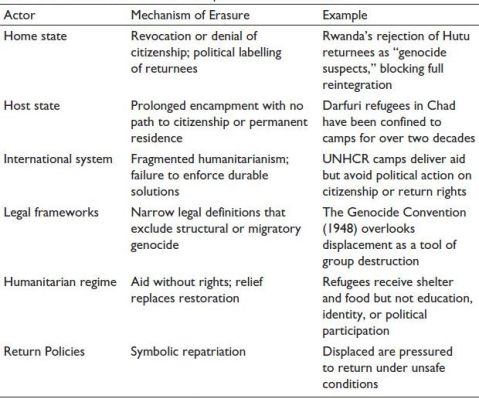
To properly address the issue, policymakers and researchers require episodic frameworks to analyze genocide. They must analyze how bureaucracies, borders, and laws are turned into instruments of erasure (Table 2). In this way, forced migration can be reframed as a political issue rather than a humanitarian catastrophe: one where the underlying logic of destruction governs even in the absence of gunfire.
Case Comparison: Rwanda and Sudan
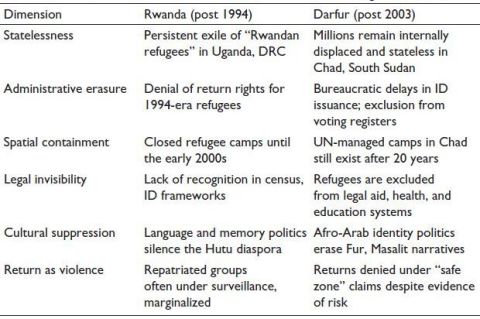
Table 1 outlines select indicators of genocidal continuation through forced migration in two key post-genocide contexts, namely Rwanda and Darfur (South Sudan). Each variable links to a dimension of social death, illustrating how migration extends the logic of group destruction across time and space.
Implications for Migration and Human Rights Policy
Overriding paradigms of humanitarian and migration rule tend to approach genocide as something with a definite terminus. International law, political intervention, and development policy are designed to work on a temporal trajectory that starts from atrocity and finishes in ceasefires, tribunals, or repatriation accords. This “aftermath” perspective, however, drastically restricts the potential of international frameworks for acknowledging and being responsive to genocidal harm’s long durée. It externalizes the survivors’ displacement and marginalization as post-genocidal “side effects” and not as continuities of the initial violence. Through this, humanitarian and migration regimes risk not only neglect but active complicity in the structural violence they purport to undo.
Table 1. Indicators of Genocidal Continuation in Post-Genocide Migration Contexts.
Sources: Hovil (2016), Manby (2011), UNHCR (2023), Mamdani (2009), Human Rights Watch (2019).
Table 2. Mechanisms of Erasure in Displacement Governance.
Sources: Hovil (2016), Manby (2011), UNHCR (2023), Mamdani (2009), Human Rights Watch (2019).
One of the most important corollaries of this reorientation, then, is that attention must be paid to how policy practices—no matter how bureaucratically dispassionate or humanitarian in purpose—have the capacity to operate as instruments of exclusion, abandonment, and erasure. Prolonged refugee crises, boundless statelessness, and return policies that value spectacles over justice are non-neutral results. They are the seen products of a system engineered more for containing than redressing. As Duffield (2007) cautions, the architecture of contemporary humanitarian governance is coming to be more defined by risk aversion, control, and geopolitical interest than by transformative justice. When repatriation is a symbolic action, or when citizenship is granted conditionally based on assimilation or political silence, these interventions, rather than restoring genocide, perpetuate it through administrative processes (Agier, 2011; Fassin, 2012).
Reassessing the Camp and the Border as Political Technologies
The perpetual exclusion of displaced populations cannot be explained without rethinking the role of borders and camps in the post-genocide configuration. Borders are not just geographical boundaries separating sovereign nations; they are regimes of regulation that structure access to rights, identity, and recognition. In situations such as that of Rwanda and Sudan, borders have turned into arenas of suspended life—places where displaced populations are caught between lawful belonging and complete exclusion. The border here becomes what might be termed a “dispositive” (apparatus) by Michel Foucault: not a receptive space but an active machinery of control, surveillance, and differential valuation of human lives.
This is compounded by what Giorgio Agamben (1998) famously theorized as the “camp”. The camp refers to a state of exception wherein legal norms are put in abeyance, and individuals are reduced to bare life—biological existence without political agency. Refugee camps worldwide, from the one in Dadaab, Kenya, to the Darfuri camps in Chad, are characteristic of this state. Although framed as humanitarian measures, such sites tend to replicate the very invisibility and powerlessness implied by genocide. In Agamben’s definition, the camp is no exception but the concealed basis of the political order, particularly in regimes of crisis management such as post-conflict zones. Effectively, the camp is the “afterlife” of genocide: a sphere in which its exclusionary logic is not eradicated but extended indefinitely.
The Illusion of Voluntary Repatriation
Perhaps the most entrenched maxim in international refugee law is the encouragement of voluntary repatriation, the notion that displaced individuals, once security conditions improve, should head back home. Alas, this maxim tends to fall apart under the pressure of geopolitics and state interests. In Rwanda and Sudan, “returns” have been mobilized as performative indications of post-genocide recovery, often neglecting the political, psychological, and material contexts of returnees. This leads to enforced normalization of unsafe returns in the name of voluntariness.
In Rwanda, for instance, Hutu refugees in the Democratic Republic of Congo have frequently been coerced into returning despite continued fears of monitoring, arrest, or deprivation of property upon return. The state’s push for repatriation is more about reinforcing political narratives of reconciliation and unity than restoring rights. In Sudan, despite conditions on the ground remaining largely unstable, Darfuris have been called back based on their peace agreements that do not resolve underlying displacement drivers or ensure security.
This trend discloses the discrepancy between principle and praxis. Voluntary repatriation, in theory, should be based on informed consent and sustainable reintegration. Practically, it is used as an instrument of depoliticization, recasting protracted displacement as a personal decision rather than as a collective harm. Policies that do not consider risks of return, or use repatriation as a measure of success, reaffirm the marginalization that they aim to eliminate.
Statelessness as Policy Design, Rather than Anomaly
The other significant implication of this redefinition is the acceptance that statelessness is not a natural or random state. In most cases, it is a direct consequence of policy choices aimed at making some populations politically inactive. Throughout post-genocide settings, citizenship has been used to involve or exclude, not just based on legal paperwork but on ethnicity, perceived allegiance, or geopolitical expediency.
In Sudan, the groups targeted in the Darfur genocide are still subjected to bureaucratic obstacles in obtaining identification documents. Without these documents, they cannot vote, have access to services, or own land. In Rwanda, too, former exiles returning from exile frequently have indeterminate legal status. Although they might be accorded de facto residence, they are excluded from full political rights, especially if they are perceived as being associated with dissident histories or diaspora opposition elements.
Global legal regimes have faltered to meet this type of exclusion. Although the 1954 and 1961 Statelessness Conventions provide models for protection, few nations are parties, and there are no effective mechanisms for enforcement. The result is a vacuum of law where states may voluntarily create statelessness with impunity. This is not a humanitarian failure; it is a human rights failure, and one that reinforces the same logics of dehumanization that characterize genocide.
Performative Humanitarianism and Reproduction of Harm
Another implication relates to the agency of international humanitarian players. While UN agencies and NGOs contribute importantly to relief efforts, they are frequently organized by short-term financing strategies, bureaucratic neutrality requirements, and geopolitical obligations. These can result in what Didier Fassin (2012) refers to as “humanitarian reason”—a logic that replaces care with justice, and administration with transformation. Aid is provided, camps are sustained, and displacement is managed, but the underlying infrastructures of exclusion are never addressed.
In fact, humanitarianism can inadvertently perpetuate the social death architecture by allowing states to subcontract their duties to international organizations. Refugees are sustained instead of incorporated. Returns are tracked instead of evaluated for equity. Citizenship is marketed as a personal solution instead of a communal right. Within this frame, humanitarianism facilitates the perpetuation of genocide, not out of ill will, but due to the bureaucratization of abandonment.
Toward Transformative Approaches: Policy Recommendations
To effectively grapple with genocide’s continuity in terms of displacement, migration and human rights policy has to conceptually and structurally change.
Conclusion
This essay has pushed a remapping of genocide not just onto the instant of mass slaughter but also onto its migratory afterlives. By regarding exile, statelessness, and long-term displacement as part of the logic of group destruction, we disrupt the hegemonic narrative that situates genocide in the past. Genocide here is not a bygone event—it is instead a continuous process that transpires across borders, laws, and bureaucracies. The rights-deprived, unrecognized, and stateless survivor is a living testament to the incomplete nature of genocidal violence.
This continuity is itself usually occluded by humanitarian and legal regimes that give priority to temporariness and emergency. Refugee camps, mechanisms of aid, and policies of return, even as they appear to be protective, can actually institutionalize the state of social death. International community members, host governments, and even post-genocide governments frequently engage, wittingly or unwittingly, in practices that put survivors in limbo, denying them justice under the guise of neutrality or stability. As this essay has demonstrated, such governance arrangements not only do not dismantle the consequences of genocide but can actually re-enact its central objective: the destruction of people’s identity, history, and future.
A response to genocide aimed at justice must thus extend beyond tribunals, memorials, and humanitarian aid. It needs to examine how migration systems, donor strategies, and legal frameworks sustain structural exclusion. Survivors are not merely in need of shelter or sustenance; rather, they require restoration: restoration of legal identity, restoration of political rights, and restoration of the ability to envision and recreate communal futures. If genocide annihilates not just life but life-worlds, then responsibility must be extended to all institutions that govern the lives of the uprooted. Only then can justice begin to confront not merely the aftermath, but the afterlife, of genocide.
Declaration of Conflicting Interests
The author declared no potential conflicts of interest with respect to the research, authorship and/or publication of this article.
Funding
The author received no financial support for the research, authorship and/or publication of this article.
Agamben, G. (1998). Homo sacer: Sovereign power and bare life. Stanford University Press.
Agier, M. (2011). Managing the undesirables: Refugee camps and humanitarian government. Polity.
Duffield, M. (2007). Development, security and unending war: Governing the world of peoples. Polity.
Fassin, D. (2012). Humanitarian reason: A moral history of the present. University of California Press.
Foucault, M. (1980). Power/knowledge: Selected interviews and other writings, 1972–1977 (C. Gordon, Ed.). Pantheon Books.
Hovil, L. (2016). Refugees, conflict and the search for belonging. Palgrave Macmillan.
Human Rights Watch. (2019). World report 2019: Rwanda and Sudan. https://www.hrw.org/world-report/2019
Mamdani, M. (2009). Saviors and survivors: Darfur, politics, and the war on terror. Pantheon.
Manby B. (2011). Citizenship law in Africa: A comparative study (2nd ed.). Open Society Foundations.
Patterson, O. (1982). Slavery and social death: A comparative study. Harvard University Press.
UNHCR. (2023). Global trends: Forced displacement in 2023. United Nations High Commissioner for Refugees. https://www.unhcr.org
