
Journal of Liberal Arts and Interdisciplinary Sciences

Pragati Chauhan1 , Ernie Cadotte2, Anandajit Goswami3, Bindu Agrawal4 and Meenal Rawat5
1School of Business, Manav Rachna University, Faridabad, Haryana, India
2Haslam College of Business, University of Tennessee, Knoxville, TN, USA
3Manav Rachna Centre of Peace & Sustainability, Faridabad, Haryana, India
4Manav Rachna University, Faridabad, Haryana, India
5School of Education & Humanities, Manav Rachna University, Faridabad, Haryana, India

This article is distributed under the terms of the Creative Commons Attribution-NonCommercial 4.0 License (https://creativecommons.org/licenses/by-nc/4.0/) which permits non-commercial use, reproduction and distribution of the work without further permission provided the original work is attributed as specified on the SAGE and Open Access page (https://us.sagepub.com/en-us/nam/open-access-at-sage).
This article examines the connection between conscious leadership practices and financial performance in a comparative study based on the Conscious Capitalism framework using a simulation. Based on modeled scenarios in the 3D-printed carbon fiber bicycle industry, the article uses the Conscious Scorecard and Balanced Scorecard to evaluate the environmental stewardship, human capital investment, community relations, health and wellness, and supply chain integrity of six companies. The results of the simulation indicate that purpose-oriented leadership practices could be linked to higher organizational resilience, whereas profit seems to be a by-product of developing a conscious culture (Bhaskar et al., 2023; Jum’a et al., 2024; Rodríguez-Aldana et al., 2024). Companies that had preinvested in staff welfare, environmental, and community relations showed better simulated recovery dynamics, and those that concentrated on short-term profits were unstable and had reputational risks. Such results add some preliminary knowledge to the Conscious Profit Matrix, suggesting that conscious leadership is a possible strategy in modeled settings. Although the findings are not supposed to be causal evidence, they can provide conceptual directions for future empirical study, as well as show possible applicability to other contexts like the Global South, where corporate social responsibility can become systemic value creation based on conscious variables.
Conscious Capitalism, conscious scorecard, conscious leadership, simulation
Introduction
Capitalism has been subject to great changes, which include mercantilism and finance capitalism, which is commonly linked to inequality and instability (Harari, 2015, 2019; Harvey, 2007). More recent critiques, like the idea of techno-feudalism by Varoufakis, point to the way digital platforms are forming rent-seeking structures instead of productive markets (Varoufakis, 2023; Polman & Winston, 2021). Such criticisms have highlighted the necessity to adopt alternative paradigms that can incorporate the principles of sustainability and social equity in business practice. One such paradigm has become Conscious Capitalism, which has introduced higher purpose, stakeholder orientation, conscious leadership, and conscious culture into organizational life (Sisodia & Mackey, 2013). This article relies on Conscious Capitalism as it is supplemented by Stakeholder Theory, to investigate how purpose-oriented leadership can have an impact on organizational resilience using simulation-based comparative analysis.
Literature Review/Theoretical Framework
Historical Critiques of Capitalism
The development of capitalism has exacerbated inequality and instability, and financial capitalism is sometimes associated with social crises like the 2007-2008 financial crisis (Harari, 2015, 2019; Harvey, 2007). Varoufakis’s opposition to techno-feudalism exemplifies the working of digital platforms as rent-seeking rather than productive markets (Polman & Winston, 2021). The critiques serve as the foundation for considering other paradigms that emphasize sustainability and equity, including Conscious Capitalism.
Principles of Conscious Capitalism
The four principles of Conscious Capitalism are Higher Purpose, Stakeholder Orientation, Conscious Leadership, and Conscious Culture (Sisodia & Mackey, 2013). These principles move organizations from the command-and-control model to a collaborative and trust-based culture (Chapman et al., 2015). In today’s age of radical transparency, these practices enable companies to obtain a social license to operate (Wallace, 2024).
Stakeholder Theory
Stakeholder Theory offers a normative basis for assessing the practices of organizations as it calls on firms to consider the needs of employees, customers, communities, and shareholders (Freeman, 1984). This approach is a complement to Conscious Capitalism, as it sees leadership decisions as part of a wider purpose to the care of the product and multiple stakeholders, further strengthening the connection between purpose-driven leadership and sustainable performance.
The Qualities of Conscious Leaders
Conscious leaders represent mindfulness, empathy, emotional intelligence, and brave action—some of the most valuable skills and qualities that used to be described as “soft skills” (Goldsmith, 2015; Lippincott, 2018; Thomas et al., 2017). Trust and empowerment strengthen participatory leadership, and vision and outlook help leaders to anticipate environmental and social risks before they become liabilities (Kelly, 2024a). These represent the characteristics of Conscious Capitalism and reinforce stakeholder-oriented decision-making, making leadership a key factor in achieving resilience. As illustrated in Figure 1, the Conscious Leadership Framework integrates these dimensions into a cohesive model of stakeholder-oriented leadership.
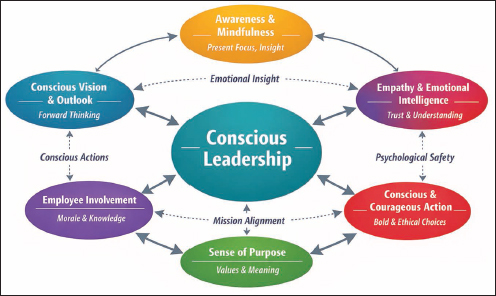
Nonjudgmental awareness of the present: Awareness and mindfulness. Impact: Helps avoid short-term myopia when leaders can determine the second-order societal implications of choices (Lippincott, 2018).
Empathy and emotional intelligence: How to control one in relation to the other, as well as other people. Impact: The key to conflict resolution and the development of trust that is necessary to work with high velocity (Thomas et al., 2017).
Sense of purpose: Finding nonprofit work satisfaction. Impact: Maps organizational activities to the company’s values, reducing brand erosion in times of crisis (Wallace, 2024).
Conscious and courageous action: Facilitating courageous choices in ambiguous settings. Impact: It builds a culture of psychological safety through which one can experiment with complex operational problems quite fast (Goldsmith, 2015).
Trust and empowerment: Nurturing participatory leadership style by being a jointly responsive leader. Impact: It will enhance operational agility by allowing those individuals who are closest to the issue to solve the issue (Jones & Brazdau, 2015).
Conscious vision and outlook: From analysis to intuition Impact: Anticipates community and environmental needs, including finding respiratory hazards of epoxy dust or poisonous seepage of chemicals, before they have developed into obligations of law or financial costs (Kelly, 2024a).
Particularly, they are intended to respond to the volatility of psychological contracts of new workforce generations, Gen Z and Gen Alpha.
Generational Imperatives
The change in generations and the rise of Gen Z and Alpha have altered the validity of leadership, focusing more on ethical decision-making, sustainability, and transparency (Csobánka, 2016). Companies that fail to address these imperatives run the risk of losing talent and losing their reputation (Kelly, 2024b). Authenticity and integrity are central to conscious leadership, which is becoming a critical part of retaining the workforce (Kelly, 2024a).
As shown in Table 1, collaboration, purpose-driven strategies, digital fluency, continuous learning, and integrity are the distinguishing characteristics of traditional leadership and conscious leadership expectations in the younger generations (Chapman et al., 2015; Sisodia & Mackey, 2013; Wallace, 2024). These demands are in line with the tenets of Conscious Capitalism and go hand in hand with the Stakeholder Theory, which urges to balance various interests among employees, communities, and shareholders.
| Dimension | Traditional Leadership | Conscious Leadership (Gen Z and Alpha) |
| Hierarchy | Command and control; top-down, rigid. | Collaboration and coaching; leaders as facilitators ( |
| Profit focus | Single-minded focus on shareholder wealth. | Purpose-driven; prioritizing the “Triple Bottom Line” ( |
| Technology | Technology as a supplementary tool. | Digital fluency; used for instantaneous feedback and rapid decision cycles ( |
| Growth | Static expertise and fixed specialized roles. | Learning-oriented; focus on continuous development of strengths ( |
| Authority | Derived from position and rank. | Derived from integrity, authenticity, and earned respect ( |
The imperatives produced, such as purpose, transparency, diversity and inclusion, well-being, sustainability, empowerment, and integrity, reflect how the generational demands reinforce the argument for stakeholder-oriented leadership. Companies that eradicate structural disparities and focus on mental health have a higher chance of attracting and keeping talent, and those disregarding transparency lose their reputations quickly in a world of available information and social justice movements (Wallace, 2024).
Business education is also changing in line with these imperatives. AACSB (2022) standards prioritize societal impact, and recent literature demonstrates that simulations can aid in the development of conscious leaders, who are prospective to meet Sustainable Development Goals (Chauhan et al., 2024; Lokhande et al., 2019). In this case, generational imperatives are not an independent theory but evidence of the context that supports the applicability of Conscious Capitalism and Stakeholder Theory to practice and pedagogy.
The Conscious Variable Framework
The application of a composite score in the measurement of corporate performance in the form of a Total Conscious Actions score is increasingly being used to investigate the potential effect of purpose-driven practices on organizational resilience (Bhaskar et al., 2023). In the simulated environment, profit comes out as a delayed result of cultures that are based on integrity, diversity, and responsibility to stakeholders (Sisodia & Mackey, 2013). The model balances proactive investments with negative conditions, and the resultant net value is corporate citizenship (Cadotte, 2014b). There are five pillars that are essential, and strategic initiatives fall under these pillars:
Environmental stewardship: Retrofitting of facilities, respirators, clean rooms, and recycling consortiums (Brown et al., 2024, ScienceDirect, 2023).
Human capital investment: Cross-training, teamwork skills, and participatory planning (Jones & Brazdau, 2015; Lokhande et al., 2019).
Community relations: School grants, technical training, construction of bike trails, and road repaving (Chauhan et al., 2024).
Health and wellness: Fitness centers, employee and family health clinics (Kelly, 2024b; Wall, 2024).
Supply chain and R&D: Sustainable packaging, rewarding quality rather than price in buying (Cadotte & Agrawal, 2022).
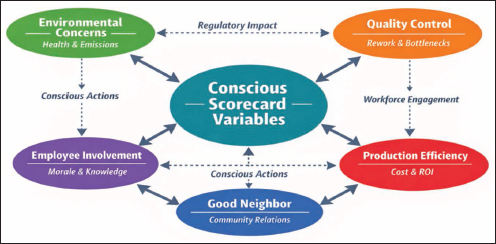
The dotted lines marked as Conscious Actions depict the ethical and strategic bridges among domains:
Environmental ↔ Employee Involvement—sustainability initiatives provide employees with pride and purpose.
Employee ↔ Community Relations—engaged employees often pioneer outreach activities.
Community ↔ Production Efficiency—positive community relations reduce friction and streamline operations.
The existence of these relationships in the simulated framework indicates that conscious actions work across domains and not in isolation. The measures of evaluation are Total Conscious Actions (positive social investments minus unresolved negative conditions), Net Profit changes, and percentages of Production Worker Compensation (Cadotte, 2014a). As shown in Figure 3, the Conscious Scorecard Variables consolidate these measures into a structured tool for assessing resilience. The scheme also tracks the incidence of strategic detonators such as the inability to increase worker compensation by at least 10% when earnings per share are above 30´. Such conditions are considered indicators of possible failures of stakeholder trust in the simulation, and the relevance of a financial performance-conscious leadership practice (Kirman & Rosen, 1999) is justified.
Methodology
In this work, a comparative multiple-case design is adopted with the help of the Marketplace Simulation—Conscious Capitalism Game, cocreated with Raj Sisodia (Cadotte, 2014a; Lokhande et al., 2019). The simulation offers a controlled setting to simulate firm-level strategies in the 3D-printed carbon-fiber bicycle sector, allowing comparative analysis of leadership choices and their effects on financial and social performance in a systematic way.
Tools and Instruments
Two diagnostic tools were used:
The Conscious Scorecard measures stakeholder-based actions and moral uprightness.
The Balanced Scorecard is a measure of traditional financial performance. These tools, combined, will incorporate both ethical and financial measures into one assessment platform.
Variables and Design
The individual firms were given a predetermined budget of 100,000 dollars, and the funds were apportioned equally into five areas of consciousness, which include environmental stewardship, quality control, employee participation, production efficiency, and community relations. This distribution is similar to the capital investment found in the follow-up study, in which every area of improvement had a price of 20,000. A six-quarter tracked decision enabled trade-off analysis between proactive investments and emergency response strategies.
Environmental concerns: Considering the liabilities and emissions (Brown et al., 2024).
Quality control: Specifying the issues of rework and bottlenecks (Wall, 2024).
Employee involvement: Assessment of morale and intellectual capital (Jones & Brazdau, 2015).
Production efficiency: Making the most of equipment return on investment and unit costs (Polman & Winston, 2021).
Good neighbor: The creation of a local brand image and local loyalty (Chauhan et al., 2024).
Data Source
The Bike Company, SAL ECO BIKES, RydiCo, Milky Way Bikes Pvt. Ltd., Carbon Edge Pro, and SERERU BIKES were six simulated firms that were observed over six quarters. Their choices were documented to evaluate balance in the Triple Bottom Line (people, planet, and profit).
Evaluation Metrics
The performance was measured using:
Total Conscious Actions (positive investments, less unresolved negative conditions).
Net Profit variations on a quarterly basis.
Workers’ compensation strategies.
Too many measures (environmental retrofits, employee education, health and wellness, supply chain enhancement, community efforts).
Simulation Validity
The study of leadership and strategy choices is suitable for simulation as it can be tested with controlled model results where there is no risk of real-life consequences. The outcomes, however, are simulated environments and cannot be generalized as empirical. They offer exploratory information and guessing to future empirical studies.
Limitations
Generalization is restricted by the use of simulated data. The six-quarter horizon limits the insights into long-term sustainability.
Research Questions
What are the influences of conscious leadership decisions on simulated financial and social performance?
What trends do Total Conscious Actions/profitability show in the simulation?
Results: Firm-level Performance
The results of the simulation shed light on how the conscious leadership choices could lead to diverse financial and social outcomes in six companies in the 3D-printed carbon fiber bicycle sector. Although the market conditions were the same and the same amount of money, 100,000, was given to each firm to use in conscious domains, their strategic decisions led to different paths. Conscious actions tended to be leading indicators of resilience, but there are exceptions to that fact that show that being profitable does not necessarily coincide with high scores on conscious actions.
The competition of six companies, that is, The Bike Company, SAL ECO BIKES, RydiCo, Milky Way Bikes Pvt. Ltd., Carbon Edge Pro, and SERERU BIKES, which are competing in a high-stakes simulation of the 3D-printed carbon fiber bicycle niche, will be analyzed in this analysis. These organizations were charged with the responsibility of balancing people, planet, and profit and sailing over the Triple Bottom Line in a six-quarter period. The proportion of firm data suggests that conscious actions are leading indicators of financial net value, and profit is often a leading indicator of conscious culture.
Cross-case Insights
High-conscious leaders (The Bike Company(60), RydiCo(56)): Both companies were heavy-handed in their investments in environmental stewardship and staff compensation, making huge losses in Quarter 4 (Q4) but recovering well in Quarter 5 (Q5). Their resilience-building through early deliberate investments is reflected by their sustainable compensation practices and their balanced interests toward stakeholders.
Volatile performer (SAL ECO BIKES): Although the conscious score (58) is high, reactive pay strategies (-6% cut and +22% increase) produced volatility and constrained profitability. This case demonstrates that disjointedness in human capital investment compromises otherwise good conscious actions.
Profitability gap (Milky Way Bikes): It scored midtier conscious (52) but had the lowest Q5 loss (-1.64 M). The virulent increase in compensation (31%) can be used to explain how socially ambitious measures, when not accompanied by operational efficiency, can cause a disruption in financial performance.
Stagnation (Carbon Edge Pro): Conscious score stagnated at 40, compensating at 0% in Q5. With this violation of the psychological contract, there was a Q5 loss (-$1.61 M), which highlights the fact that disregard for employee welfare undermines trust and profitability.
Low-conscious outlier (SERERU BIKES): Even though the conscious score is lowest (33), SERERU reported a Q5 profit (809,301). Nonetheless, this one-time benefit came at a very low price (2% growth) and with ignorance of the environmental issues that endanger the company to both long-term regulatory and reputational risks.
Contradictory Findings
High conscious, low profit means that, in order to be profitable, Milky Way Bikes must be conscious, but fiscal discipline should be a supplement to social ambition.
Low conscious, positive profit: SERERU BIKES demonstrates that profitability in the short term may be attained with little conscious investment, but this approach is unsustainable and may eventually lead to instability.
Tables for Comparative Clarity
Tables 2 and 3 give comparative snapshots and ranked views of firm results. They can be combined to demonstrate that conscious scores usually correspond with profitability, but nonconformity (Milky Way, SERERU) shows the need to balance the investments of stakeholders and the efficiency of operations.
| Firm | Total Conscious Actions (Rank) | Net Profit (Q5) | Worker Comp. % Change (Q5) | Strategic Outlook | Exhaustive Actions Taken |
| The Bike Company | 60 (1) | $2,347,311 | 8 | Market leader: High efficiency | Environmental retrofits, protective gear, clean room, recycling consortium, air plants; cross-training, planning, teamwork; SPC program, operator training; supplier quality programs; fitness, daycare, clinics (employees + families); school grants, trails, technical school; sustainable packaging, enriched carbon fiber R&D; steady compensation hikes across all levels. |
| SAL ECO BIKES | 58 (2) | $403,930 | 22 | Reactive: Volatility friction | Environmental retrofits, protective gear, recycling consortium, air plants; cross-training, planning, teamwork; SPC program, operator training; supplier quality programs; fitness, daycare, clinics; school grants, trails; limited R&D; volatile compensation (−6% cut Q3, +22% hike Q5). |
| RydiCo | 56 (3) | $1,315,205 | 0 | Balanced: Operational discipline | Environmental retrofits, protective gear, air plants; cross-training, planning, teamwork; SPC program, operator training; supplier quality programs; fitness, daycare, clinics; school grants, trails, parks; enriched carbon fiber R&D; flat worker pay Q5 but 21% hikes for supervisors and sales in Q4. |
| Milky Way Bikes | 52 (4) | −$1,640,630 | 7 | High risk: High burn rate | Clean room, air plants, recycling consortium; cross-training, planning, teamwork; SPC program, operator training; supplier quality programs; fitness, daycare, clinics; school grants, trails, parks; sustainable packaging, enriched carbon fiber R&D; aggressive compensation hikes (31% workers, 15% supervisors, 17% sales). |
| Carbon Edge Pro | 40 (5) | −$1,611,290 | 0 | Stagnation: Contract breached | Protective gear, partial retrofits; cross-training, teamwork; operator training; supplier quality programs; health clinic (employees + families); school grants, trails, parks; enriched carbon fiber R&D; sharp 25% hike Q3, flat Q5. |
| SERERU BIKES | 33 (6) | $809,301 | 2 | Vulnerable: Race to the bottom | Late retrofits, limited protective gear; minimal training; SPC program; weak supplier engagement; basic clinic (employees only); small parks, limited trails; enriched carbon fiber R&D; very low compensation increases (2% workers Q5). |
Note: SPC: Statistical process control.
| Firm | Total Conscious Actions (Rank) | Net Profit (Q5) | Worker Comp. Strategy | Strategic Classification |
| The Bike Company | 60 (1) | $2,347,311 | Consistent (8% increase) | High-conscious leader |
| SAL ECO BIKES | 58 (2) | $403,930 | Reactive (−6% cut, then 22% hike) | High-cost/volatile path |
| RydiCo | 56 (3) | $1,315,205 | Front-loaded (21% supervisor/sales) | Balanced strategic model |
| Milky Way Bikes | 52 (4) | −$1,640,630 | Socially ambitious (31% hike) | Profitability gap |
| Carbon Edge Pro | 40 (5) | −$1,611,290 | Breach of psychological contract (0% hike) | Conscious stagnation |
| SERERU BIKES | 33 (6) | $809,301 | Minimal (2% change) | Low-conscious outlier |
Discussion: The Conscious Profit Matrix
Core Argument
Conscious capitalism is necessary for long-term resilience. Even though initial costs are unavoidable, they ensure the social license of the business and give it multimillion-dollar changes in profits (Cadotte, 2014b).
Framework in Action
The Bike Company and RydiCo: Early investments in environmental stewardship, employee engagement, and compensation stability produced high conscious scores and profitability.
SAL ECO BIKES: Inconsistent human capital investment eroded otherwise strong conscious behaviors.
SERERU BIKES: Short-term gains achieved by neglecting environmental and social imperatives expose long-term risks.
Milky Way Bikes: Overinvestment in compensation without operational balance led to losses despite midtier conscious scores.
Carbon Edge Pro: A breach of the psychological contract through frozen compensation undermined liquidity and trust (Kirman & Rosen, 1999).
Generational Imperatives
The results are consistent with the purpose, transparency, diversity, equity, and inclusion, well-being, sustainability, empowerment, and integrity expectations of Gen Z and Alpha (Csobánka, 2016; Kelly, 2024a, 2024b; Wallace, 2024). Companies that do not pass these imperatives could end up with damaged reputations and a loss of talent.
Comparative Case Study Analysis: Similarities and Dissimilarities
Similarities in Strategic Trajectory
Both the Bike Company and RydiCo took on an aggressive early investment, recording Q4 losses (c. $2.1 M-$2.2 M) but with good Q5 recoveries.
This shows that front-loaded conscious investment is an important predictor of resilience (Cadotte & Agrawal, 2022).
Differences in Implementation
The Bike Company and RydiCo both pursued aggressive early investments, incurring Q4 losses (≈$2.1 M-$2.2 M) but achieving strong Q5 recoveries.
This demonstrates that front-loaded conscious investment is a leading indicator of resilience (Cadotte & Agrawal, 2022).
The Central Conclusions: Connections Between Conscious Culture and Net Value
Balance Required
The Conscious Profit Matrix illustrates that it is possible to find success in striking a balance between social ambition and fiscal discipline. Conscious leadership is not an idealistic dream but a realistic model of resiliency. Companies that incorporate stakeholder responsibility into business are more resilient to volatility and ensure legitimacy in volatile markets (Sisodia & Mackey, 2013; Wallace, 2024).
Case Insight
Profitability gap: Milky Way Bikes demonstrates the dangers of disequilibrium. An unsustainable burn rate was caused by a socially ambitious 31% pay increase that was not accompanied by an equal amount of operational optimization and led to substantial financial losses. The case demonstrates that conscious activities should be aligned with efficiency and fiscal soundness to prevent a profitability gap.
Leadership Development Framework
To successfully overcome these pressures, firms need to implement a systematic leadership development framework that is founded on three levels:
Level 1: Strategic balance: A balance between societal desire and financial restraint needs to enhance resilience, not compromise liquidity.
Level 2: Leadership modes.
Leadership among equals: Psychological safety: The leader encourages employees to express concerns and share ideas without the threat of reprisals. It is this inclusivity that enhances shared responsibility in high-stakes decisions (Chapman et al., 2015).
Skills of accountability: The functional experts should put into practice the principle of do no harm in the operations and have finance, human resources, operations, and R&D adopt ethical responsibility in their areas of expertise (Kirman & Rosen, 1999).
Authority-based leadership: The executive authority must be used to generate shared stakeholder value as opposed to self-interest. Companies work more effectively when leaders are involved in consciously integrating action into strategy, instead of approving it passively (Kelly, 2024a).
Level 3: Strategic detonators versus conscious benefits: The simulation sheds light on the implications of not addressing strategic detonators such as not increasing pay when earnings per share is higher than 30´, exposing staff to toxic epoxy dust, or selling unsafe products. Such behavior destroys trust and reputation immediately. On the other hand, companies that adopt purposeful business gains such as minimizing rework, optimizing logistics, and obtaining the social license to operate attain long-term profitability and sustainability (Polman & Winston, 2021).
Synthesis: Closing the Conscious Capitalism to Corporate Social Responsibility Guidelines in the Global South
Between compliance and strategy: According to the findings, corporate social responsibility (CSR) in the Global South, particularly in India, is rather compliance than strategy. The Conscious Variable Framework offers a gateway to change CSR into a business engine that deals with the local realities, entrenching resilience and legitimacy into organizational practice.
Localized Applications of Conscious Capitalism
Good neighbor initiatives: Grant programs and technical training can respond to the dire requirements of India in terms of developing vocational skills, which will ensure that there is a stream of skilled local workers (Brown et al., 2024).
Health and wellness: On-site clinics serve employees and families to fill gaps in healthcare systems, boosting attendance, loyalty, and stability in the workforce (Kelly, 2024b).
Environmental stewardship: Recycling and complying with sustainability legislation through producer consortiums can aid firms in evading future liabilities, as well as in aligning with regulatory expectations (Polman & Winston, 2021).
Human capital development: Cross-training will transition workers away to become stakeholders, which will result in agility and innovation in rapidly expanding economies (Jones & Brazdau, 2015).
Supply chain integrity: When purchasing agents are rewarded for quality and sustainability and not on cost, this will enhance the resilience of the value chain (Cadotte & Agrawal, 2022; Tang et al., 2024).
Contract Psychological in High-growth Economies
It is extremely important to align the psychological contract. The compensation increase of 10% when the earnings per share reaches a certain level is not an act of discretion but a competitive advantage in maintaining talent in India. Through a promise to share success, companies can reduce inequality, decrease turnover, and ensure long-term loyalty (Kirman & Rosen, 1999).
Global South business schools and companies need to transform into Higher Ambition Institutions, which incorporate purpose, people, and planet in their strategic management. This change is guaranteed so that they contribute more to society than they take. The only thing that can be sustained in such volatile contexts is conscious leadership that generates systemic value, builds resiliency, and produces meaningful impact on society, as well as a high financial payoff.
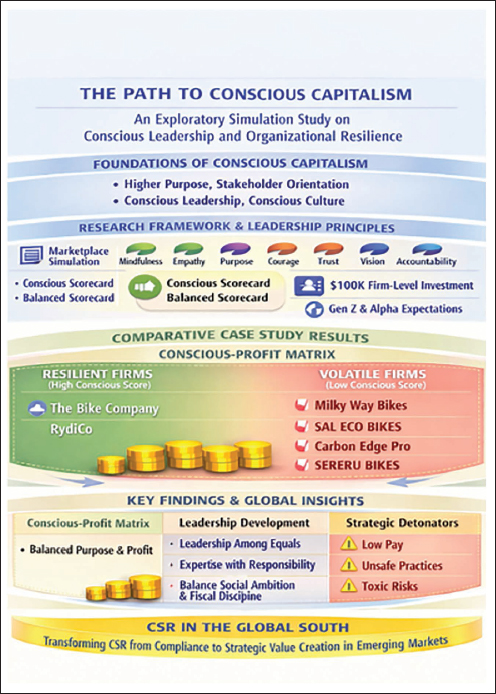
Figure 3 shows the Conscious Capitalism Framework created in this research. It links theoretical and leadership development trends and CSR practices in the Global South to show how conscious culture can be applied to systemic value creation. This integrative model shows that conscious leadership is not only a moral requirement but also a strategic requirement of firms that want to be resilient and legitimate in new markets, especially the Global South, where stakeholder-oriented leadership is necessitated by volatility and legitimacy issues.
The authors declared no potential conflicts of interest regarding the research, authorship, and/or publication of this article.
The authors received no financial support for the research, authorship, and/or publication of this article.
Pragati Chauhan https://orcid.org/0000-0003-3371-5283
AACSB. (2022). 2020 guiding principles and standards (2022 updated version). https://www.aacsb.edu/–/media/documents/accreditation/2020–aacsb–business–accreditation–standards–jul–1–2022.pdf
Bhaskar P., Bhaskar P., Anthonisamy A., Dayalan P., & Joshi A. (2023). Inhibiting factors influencing adoption of simulation–based teaching from management teacher’s perspective: Prioritisation using analytic hierarchy process. International Journal of Learning and Change, 15(5), 529–551. https://doi.org/10.1504/IJLC.2023.133110
Brown J., Dinning T., & Wall T. (2024). Developing entrepreneurial sustainability thinking and action at ‘The World Café’. In Wall T., Trevisan L. V., Filho W. L., & Shore A. (Eds.), Sustainability in business education, research and practices (pp. 303–322). Springer.
Cadotte E. R. (2014a). The use of simulations in entrepreneurship education: Opportunities, challenges and outcomes. In Morris M. H. (Ed.), Annals of entrepreneurship education & pedagogy (pp. 280–302). Edward Elgar Publishing.
Cadotte E. R. (2014b). Metrics for mentors. BizEd. AACSB International.
Cadotte E. R., & Agrawal B. (2022). Time for educators to lead on societal impact. AACSB.
Chapman D., Dethmer J., & Klemp K. (2015). The 15 commitments of conscious leadership: A new paradigm for sustainable success. Conscious Leadership Group.
Chauhan P., Cadotte E. R., & Agrawal B. (2024). The conscious leadership paradigm: A necessity for business schools. In The Elgar companion to management education and the SDGs (pp. 282–294). Edward Elgar Publishing.
Csobánka Z. E. (2016). The Z generation. Acta Technologica Dubnicae, 6(1), 1–6.
Freeman R. E. (1984). Strategic management: A stakeholder approach. Pitman.
Goldsmith M. (2015). Triggers: Creating behavior that lasts—Becoming the person you want to be. Crown Currency.
Harari Y. N. (2015). Sapiens: A brief history of humankind. Harper.
Harari Y. N. (2019). 21 lessons for the 21st century. Vintage.
Harvey D. (2007). A brief history of neoliberalism. Oxford University Press.
Jones V., & Brazdau O. (2015). Conscious leadership, a reciprocal connected practice: A qualitative study on postsecondary education. Procedia–Social and Behavioral Sciences, 203, 251–256.
Jum’a L., Qamardin S., & Ikram M. (2024). Developing resilience strategies amid supply chain risks in the automotive industry: A stakeholder theory perspective. Business Strategy and the Environment, 33(8), 9197–9213. https://doi.org/10.1002/bse.3977
Kelly J. (2024a). Embracing trust over control: The evolution of conscious leadership. Women in Higher Education, 33(9), 1–2.
Kelly J. (2024b). Empowering women leaders in higher education: The path to conscious awareness. Women in Higher Education, 33(3), 1–2.
Kirman B. L., & Rosen B. (1999). Beyond self–management: Antecedents and consequences of team empowerment. Academy of Management Journal, 42(1), 58–74.
Lippincott M. (2018). Deconstructing the relationship between mindfulness and leader effectiveness. Leadership and Organization Development Journal, 39(5), 650–664.
Lokhande M., Cadotte E. R., & Agrawal B. (2019). Molding conscious leaders. South Asian Journal of Business and Management Cases, 8(3), 262–275.
Polman P., & Winston A. (2021). Net positive: How courageous companies thrive by giving more than they take. Harvard Business Press.
Rodríguez–Aldana M. L., López–Vázquez L. P., & Rodríguez–Aceves L. (2024). Conscious business practices as a driver of reputational capital in SMEs. Revista Brasileira de Gestão de Negócios, 26(3), e20230181. https://doi.org/10.7819/rbgn.v26i03.4274
ScienceDirect. (2023). Sustainably engaging employees in food wastage reduction: A conscious capitalism perspective. Journal of Cleaner Production, 389, 136091. https://doi.org/10.1016/j.jclepro.2023.136091
Sisodia R., & Mackey J. (2013). “Conscious capitalism” is not an oxymoron. Harvard Business Review.
Tang M., Liu Y., & Yang H. (2024). Organizational resilience in digital transformation: A stakeholder perspective. Journal of Xihua University (Philosophy & Social Sciences), 43(6), 74–87. https://doi.org/10.12189/j.issn.1672–8505.2024.06.008
Thomas C. L., Cassady J. C., & Heller M. L. (2017). The influence of emotional intelligence, cognitive test anxiety, and coping strategies on undergraduate academic performance. Learning and Individual Differences, 55, 40–48.
Varoufakis Y. (2023). Technofeudalism: What killed capitalism. The Bodley Head.
Wall T. (2024). Ethics in leadership learning and development: From infusing to insisting. In Young G., Dixon J., & Craig K. (Eds.), Leading beyond the ego: How to become a transpersonal leader (pp. 328–338). Kogan Page.
Wallace N. (2024). Future–proofing organizations with conscious leadership. Leader to Leader, 2024(114), 61–68.
