
Journal of Liberal Arts and Interdisciplinary Sciences


1Jawaharlal Nehru University, New Delhi, Delhi, India

Creative Commons Non Commercial CC BY-NC: This article is distributed under the terms of the Creative Commons Attribution-NonCommercial 4.0 License (http://www.creativecommons.org/licenses/by-nc/4.0/) which permits non-Commercial use, reproduction and distribution of the work without further permission provided the original work is attributed.
The article examines multiple dimensions of vulnerability among informal labourers in India and critically evaluates existing social protection systems. Drawing on fieldwork conducted across five districts in Uttar Pradesh and two in Rajasthan, the study unravels issues such as unstable employment, delayed payments, digital divides and caste–gender hierarchies shaping the lives of this workforce. Initiatives such as MGNREGA, e-SHRAM, Ayushman Bharat and building and other construction workers welfare boards are assessed for their delivery effectiveness. A comparison between Uttar Pradesh and Rajasthan highlights the crucial role of civil society organizations in entitlement delivery and enhancing institutional accountability. Based on empirical evidence and supplementary sources, the article argues for abandoning fragmented technocratic approaches in favour of a universal social protection model grounded in a rights-based framework that better responds to local needs. Policy recommendations focus on addressing structural marginalization among informal workers.
Informal labour, living security, social protection, MGNREGA, e-SHRAM, civil society, migrant workers
Introduction
The labour market in India primarily comprises an informal economy where over 90% of the population is engaged in precarious employment that is neither lawfully recognized nor offers employment security or access to social protection (MoSPI, 2023; NSSO, 2019). These casual labourers, on whom key sectors such as agriculture, construction, domestic service and small-scale production depend, remain formally excluded from formal labour arrangements and income security entitlements (ILO, 2018; World Bank, 2021). Informality in India is not merely transitional; instead, it is an institutionalized structure shaped by a political economy characterized by low wages and reduced law enforcement (Herring, 2015; Harriss-White, 2004; NCEUS, 2007).
The vulnerabilities embedded in informal employment are multidimensional. Workers are exposed to unstable earnings, a lack of a redress system, inadequate health coverage and retirement benefits, unsafe environments and a lack of legal support in case of disputes (Bhattacharya, 2019; Mehta & Singh, 2021). All these risks are exacerbated by socio-economic conditions such as caste, class, gender and migratory status (Dreze & Sen, 2013; Sen & Dreze, 1995). The research indicates that Dalits and Adivasis are disproportionately employed in low-paid, high-risk and insecure enterprises (Breman, 2013; Gupta & Iyer, 2020). Informal female workers face significant burdens: They perform both paid work and unpaid care and are also consistently excluded from managerial or administrative positions (ILO, 2021; Kabeer, 2019). Often invisible to welfare provisions in both their origin and destination states, migrant workers are frequently undocumented at their destinations, potentially remaining unaccounted for (Bhan et al., 2020; Deshingkar & Akter, 2009; Reddy & Sekher, 2017).
The inefficiency of the fragmented welfare system in India was clearly illustrated by the COVID-19 pandemic. When a nationwide lockdown was declared in March 2020, millions of migrant workers found themselves susceptible to a crisis revealing a lack of food security, transport support or direct income payments (Roy & Kumar, 2020). Based on reports, as many as 73% of all the potential informal workers who were to be registered on systems to allow them to get ration entitlements or cash benefits failed to do so either due to Aadhaar mismatch, failure to get themselves registered on the systems, or due to exclusion of the digital systems (Ray & Subramanian, 2020; SWI, 2021; Sinha & Mehta, 2021). Reality of exclusion was a reflection on the necessity to reform the social protection regime in India and move to a regime that is grounded in the principles of rights and the universality (Ghosh, 2020; ILO, 2021).
This article is a critical review of the social–economic vulnerabilities of the informal workers and the ability of the currently existing social protection measures to tackle them. In particular, it endeavours to address the following questions: To what extent are the existing social protection schemes effective to reduce the multidimensional precarity that informal labourers experience and how can differences in how they are implemented and the extent to which they affect people across regions be explained? It is based on primary fieldwork in five districts in the state of Uttar Pradesh (Sitapur, Hardoi, Barabanki, Unnao and Lucknow) as well as two districts in the state of Rajasthan (Ajmer and Rajsamand) to describe the experience of workers under the schemes of Mahatma Gandhi National Rural Employment Guarantee Act (MGNREGA), e-SHRAM, Ayusman Bharat and Building and Other Construction Workers (BOCW) Welfare Board. It talks about the importance of local governance, civil society engagement and the issue of technology in the determination of access to rights. The argument of the article based on secondary data and literature is that there is a need to reform the system and processes of livelihood security, hitherto characterized by the technology-managed, top-down, to a decentralized, inclusive and rights-based system. The article first presents the methodological approach, outlines and discusses key empirical findings and then concludes and gives future research directions.
In India, informal work occupies a wide variety of activities, such as construction, domestic labour, manufacturing at home, agricultural services and small-scale trade (MoSPI, 2023). Such forms of labour are generally described as having no formal contracts, uneven remuneration support, a dangerous work environment and poor social security, especially in reference to pensions, expendable insurance, healthcare, medical care and provisions funds (NCEUS, 2007). The absence of institutional dispute-resolution mechanisms for most informal employees creates a high risk of exploitation, as they have limited direct legal avenues for seeking justice. India’s widespread informality takes distinct forms across rural and urban settings. In rural areas, it typically involves seasonal agriculture or MGNREGA work, while urban informal employment encompasses daily wage, domestic and other precarious jobs. Far from a temporary phase, Indian informality is an entrenched institution characterized by low wages and weak law enforcement, shaped by its unique political economy (Harriss-White, 2004; NCEUS, 2007).
Insecurity of informal workers is driven by three dimensions that are related to the instability of work, lack of protective labour regulations and the limited collective voice. To begin with, informal employment is precarious in nature, which relies on other factors such as seasons, weather, flux in demand and the often-volatile market. Second, there are no statutory rights like sick leave, wage security and occupational health and safety standards. Third, informal labourers lack access to the labour unions, collective bodies and official system of appeals to the authorities (ILO, 2021), which once again marginalizes them and makes it more difficult to seek redress.
This structure deeply embeds caste and gender issues. Dalit and Adivasi workers are disproportionately in the most precarious and unprotected jobs (Breman, 2013; Mohanty & Pati, 2020), often suffering wage theft, discrimination and assignment to manual-intensive tasks. Moreover, women labourers face additional disadvantages, with risks from gender pay gaps, unequal childcare access, limited supervisory roles and domestic burdens increasing their precarity (Patel & Desai, 2018). A nuanced understanding reveals how intersecting forms of patriarchy and informality compound these challenges (Nair, 2023; Taneja, 2022). Furthermore, the notion that the ‘state’s welfare system purports to be neutral’ but reproduces and even entrenches existing inequalities demands critical examination (Venkatesh & Reddy, 2019). Many women work in home-based or piecework arrangements, which, despite being labour-intensive, frequently fall outside current welfare systems (Chen, 2012; Deshpande, 2020; ILO, 2021).
Migrant informal workers are in a particularly precarious situation. Internal migrants, largely seasonal rural–urban labourers, often lack legal protections from both their home and host states. At host sites, they commonly do not have ration cards, and their registration in national databases like e-SHRAM and the One Nation One Ration Card (ONORC) is often incomplete or faulty (Agarwal et al., 2020; Deshingkar & Akter, 2009). Construction, brick kiln and domestic workers often experience wage theft and lack proper housing, sanitation and health facilities.
The intersecting vulnerabilities of occupation, caste, gender and migration status confirm that informal employment is not neutral. Instead, it is a socially and politically constructed category that creates hierarchies and exclusions, even in so-called protective institutions. Although the analysis by Drèze and Oldiges (2022) forms the very basics of technological intervention, a more broadly theorized interconnection of digital governance and vulnerable groups, supported by the similar readings of Pariroo Rattan in their analysis of the concept of Digital Developmentalism and Street Vending (2025), further emphasizes that digital tools have often disempowered rather than enabling workers. Jan Breman and Barbara Harriss-White state that Indian informal work not only is unemployable but can be described as consciously disempowering. Its popularity stems from its versatility, low cost and ability to bypass formal accountability. Therefore, a robust understanding of informal employment must move beyond mere statistics. It must instead scrutinize structural forces like economic liberalization, weak labour law enforcement, caste patriarchy and the gradual shrinking of the welfare state, all of which determine who benefits, who is excluded and who never accesses state support.
The article is structured as follows: The second section details the research methodology, including site selection, sampling and qualitative methods. The third section presents fieldwork observations from Uttar Pradesh and Rajasthan. The fourth section analyses the major findings and systemic explanations for disparities in scheme implementation. The fifth section concludes with policy recommendations and implications for universal social protection.
Research Methodology
The article will be based on primary field work in five districts of Uttar Pradesh (Sitapur, Hardoi, Barabanki, Unnao and Lucknow) and two districts of Rajasthan (Ajmer and Rajsamand). The aim of the study was to understand the lived experiences of workers in the major social protection policies, including MGNREGA, e-SHRAM, Ayushman Bharat and BOCW Welfare Board.
Mainly, the qualitative methodology was applied in the field work, including in-depth interviews and focus group discussions with informal workers, local communal leaders, gram panchayat members and local members of the Civil Society Organization (CSOs). The approach was adopted under this theme to ensure a detailed understanding of complex, multidimensional experiences of vulnerability that are mostly rampant in the informal sector and the challenges these workers face in accessing social protection systems.
These specific districts were chosen on the consideration of a variety of informal labour markets, socio-economic conditions and different variations in the implementation of schemes. The districts selected in Uttar Pradesh are representative of a combination of rural and peri-urban regions that have numerous informal work type and the challenges noted in the implementation of major projects such as the MGNREGA. Ajmer and Rajsamand were chosen in Rajasthan for their more successful implementation of the social protection schemes and the high activity of civil society organizations (including Mazdoor Kisan Shakti Sangathan (MKSS)), as documented in the existing sources. This intentional selection made comparative analysis of different institutional and grassroots actions possible, permitting us to understand how it contributes to the outcomes of informal workers.
Fieldwork Observations: Uttar Pradesh and Rajasthan
The situation becomes evident in the result of a comparative study across five districts of Uttar Pradesh and two districts of Rajasthan. Awareness of beneficiaries and responsiveness of the institutions turned out to be highly different in selected places of both states. These disparities may be explained by the differences in the ability to govern at the local level, the magnitude and nature of involvement of the civil society and varying rates of digital preparedness.
This section elaborates on the insights provided through the fieldwork as well as draws on comparative tables to represent the differences and similarities evident in the process of implementing social protection schemes in Uttar Pradesh and Rajasthan. The tables will enable empirical findings more convincing and comprehensible, offering the quick overview of the systematic differences across variables. Table 1 presents a comparative review of the efficiency of the major social protection schemes in both states, which invalidates the empirical basis of the arguments developed in this article. The visual representation of these variations strengthens the overall case of the central argument of the article regarding the criticality of local variables (CSOs, governance) even more strongly. It becomes much easier to directly quote specific results to be later used in discussion and in the policy imperatives.
Table 1. Comparative Effectiveness of Major Social Protection Schemes in Uttar Pradesh and Rajasthan.
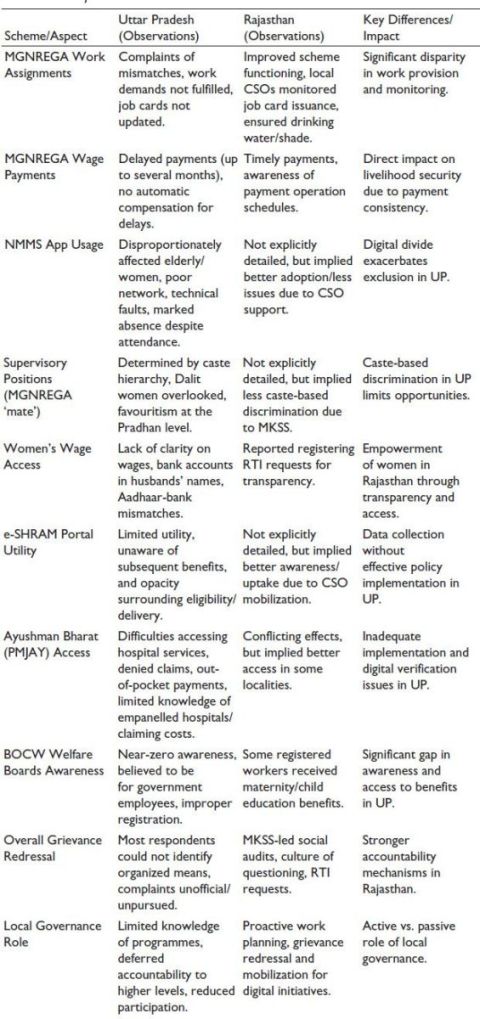
In contrast, a sizeable percentage of MGNREGA employees in Uttar Pradesh grumbled about work allocation mismatch and delayed wages. Some villagers stated that their work requirements have not been met or their job card has not been updated. The issue of attendance was worsened by the addition of the NMMS app as a photo-based attendance system, which mostly disadvantaged the elderly and the female participants who did not have smartphones or access to stable internet signals. Employees in Unnao and Sitapur claimed that they were marked absent because of technical glitches despite doing full day work. In the peri-urban region of Lucknow, migrant street vendors and migrant construction workers were not granted any of the fringe or rural benefits in addition to their city benefits.
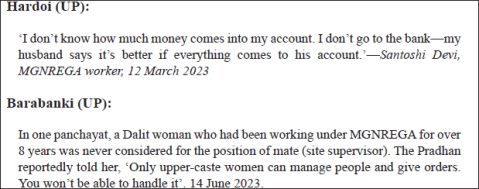
It was not just the digital exclusion, but caste hierarchy also affects supervisory roles like ‘mate’ positions in MGNREGA. In Hardoi and Barabanki, Dalit women were alleged to be ignored regardless of their seniority and experience. In some gram panchayats, nepotism on Pradhan level led to the ad hoc allocation of work to the members of the dominant caste or families. Another challenge was that majorities of women do not have a clear notion of their salaries or access to their bank accounts, as they were usually named on their husbands’ accounts, or they were blacklisted due to the Aadhaar-bank mismatch issue.
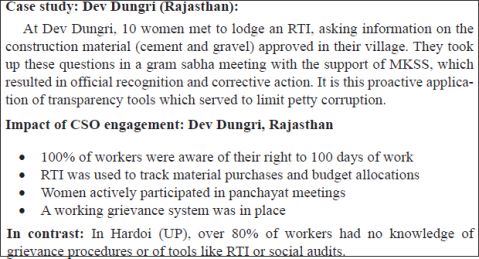
On the contrary, Rajasthan showed a better functioning of the schemes and greater awareness in the villages of Ajmer and Dev Dungri. The presence of MKSS was instrumental in reducing the gap between policy and practice. Dev Dungri labourers could very well explain their rights, such as 100 days of work guarantee, wage payment periods, grievance redressal mechanisms and the importance of social audits. Women of these villages stated that they filed right to information (RTI) applications demanding clarity into muster rolls and materials procurement. This has created an inquiry culture, helped by the high level of civil society engagement and local-level officials.
A comparative contrast was observed in the administration of Gram panchayats in Rajasthan and in Uttar Pradesh. In Rajasthan, the elected committees were proactive in terms of work planning, grievance redressal and mobilizing residents towards digital literacy in e-SHRAM registration and Ayushman Bharat cards. Conversely, the Panchayat-level officers in Uttar Pradesh had poor knowledge about various programmes of the government and had a tendency to transfer responsibilities to a higher level of government administration. This dilution of the responsibility introduced confusion among field workers, and the level of participation of the panchayat was diminished significantly.
Similar disparities were evident in the implementation of BOCW welfare boards. Some of the registered construction workers in Rajasthan reported that they were provided with maternity and child education allowances. In Uttar Pradesh, however, the awareness of BOCW schemes was almost zero among the beneficiaries. Field investigators asserted that the majority of the informal construction employees were poorly registered and unaware of the mechanisms to access these benefits.
The empirical evidence reveals a significant variation in the execution of the nationwide programmes, directly linked to the existence or lack of community mobilization, effective local governance and strong grievance mechanisms. Rajasthan is the best example of what can be done with grassroots activism and the strong partnership between governments and civil society. Uttar Pradesh is an indicator of how exclusion persists despite all the apparent efforts of having a programme, when this was not effectively happening at the grassroots level.
Major Findings and Explanations
The reasons identified in the article of underlying dissimilarities in the implementation of welfare schemes, awareness of the beneficiaries and responsiveness of the institutions across Uttar Pradesh and Rajasthan are due to differences in capacities of local governance, scale and quality of civil society engagement and level of digital preparedness. This section will explore these in depth. It does not simply observe but attempts to describe why and how such disparities occurred and their systemic consequences.
This diverse and vivid gap in scheme outcomes witnessed in Rajasthan and Uttar Pradesh is significantly influenced by the presence and nature of civil society involvement. In Rajasthan, MKSS is an excellent example of how active intervention of the civil society leads to the better functioning of schemes and empowerment of workers.
MKSS not only is present but also performs specific interventions that make a difference. They have also played a crucial role in the mobilization of workers through repeated campaigns and community meetings to educate workers in their rights, such as the right to 100 working days and wage payment cycles. Their activism especially enabled the submission of RTI petitions, which were instrumental in demanding transparency in muster rolls and procurement of materiel. Moreover, social audits, which were organized by MKSS, introduced a strong feedback process between workers and authorities, making them accountable and responsive, which was largely absent in Uttar Pradesh. All of these direct interventions in job card tracking, more attentive management of wage payment records, making requests under the RTI act and social auditing, have direct results in transparency, accountability and, indeed, empowerment of workers, which shows in a clearly improved operation of the schemes.
Conversely, the weak or absent CSO infrastructure in Uttar Pradesh is also among the reasons for noted scheme failures. This disparity stems from various factors, such as historical settings that have formed state–civil society relations, varying state policies regarding NGOs and, possibly, the more fragmented local political environment, which has not fostered collective action. Without systematic and continuous struggle, Uttar Pradesh workers are usually ignorant of their rights, have no avenues to collectively raise their grievances and are victims of unaccountable bureaucratic apathy and corruption.
Local governance capacity and role, especially at the gram panchayat level, becomes another crucial factor. As could be witnessed in Ajmer and Dev Dungri in Rajasthan, elected committees were proactive in planning their work and resolving grievances, besides mobilization of residents in digital activities such as e-SHRAM registration and Ayushman Bharat. This encouraged a culture of accommodative local officers and citizen input, which led directly to improved scheme delivery and accountability.
Conversely, the panchayat-level officers of Uttar Pradesh often demonstrated limited understanding of government schemes and usually deferred responsibilities to higher administration. This knowledge gap and the problem of accountability are multifaceted in nature. They can probably be attributed to some combination of a lack of training of local officials, a lack of resource allocation towards panchayats, political intervention that erodes local autonomy and a weak culture of accountability, in which non-performance has few consequences. This dilution of responsibility creates a lot of uncertainty among the fieldworkers and severely undermines participation and trust levels at the panchayat level that results in systematic scheme failures.
Although poor network reception contributes to the problem, the issues of digital readiness extend far beyond connectivity, revealing a structural question of power and access. The NMMS app available in UP disproportionately affected the elderly and women without smartphones or reliable internet. This indicates that there are wider digital infrastructure imbalances between Uttar Pradesh and Rajasthan. Better digital readiness is implied due to stronger local governance and CSO mobilization, facilitating digital literacy.

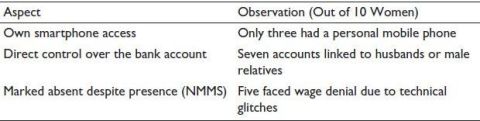
Using digital tools such as Aadhaar-based payments, mobile attendance applications and biometric authentication without addressing the underlying socio-economic inequalities, such as access to smartphones, digital literacy and gender-based restrictions in mobility, exacerbates existing inequalities and exclusions. This transforms an apparent technical issue into a structural issue of power and access. As an example of an anecdotal finding in Uttar Pradesh, women were sometimes denied work simply for lacking smartphones or in remote places where network transmission was unreliable, practically barring workers from showing up to work, regardless of their physical presence. Women, the elderly and Scheduled Caste families are particularly disproportionately affected due to limited access to technology, have less access to digital literacy and higher social barriers to mobility and resource access (Table 2). Thus, digital exclusion is directly related to the very premise of the article that ‘informality being socially and politically constructed’.
The key social protection initiatives targeting the informal labourers will be evaluated on the basis of fieldwork, empirical evidence and proven secondary literature. Though such schemes have the goal to create a conceptual support framework, they are usually hampered by administrative barriers, technological exclusion and a lack of programme convergence.
MGNREGA remains the most important rural safety net scheme targeting the informal workforce by assuring a household of 100 days of employment every year. However, in Uttar Pradesh, the interviewees consistently reported a lack of work, delayed payments (it might take months) and job card updates were not recognized. The mandatory application of the NMMS app, where geo-tagged pictures needed to be posted twice a day, was especially discriminating. Many workers also found their names falsely marked absent due to bad network coverage, lack of training or misinformation about the app. Such findings are consistent with the data at the national level, where digital tools have served as a source of disempowerment rather than empowerment of workers (Drèze & Oldiges, 2022).
Table 2. Barriers Faced by Women Workers in Accessing Digital Systems—Hardoi, UP.
In contrast, Rajasthan shows a more promising development trend. In this case, MGNREGA was implemented fairly closely to what appeared to be an ideal: local civil society organizations monitored distribution of job cards, provided drinking water and shade at the worksites, and, in general, increased vigilance of public wage payment records. Workers were aware of the demand system and payment schedules. Social audits took place on a regular basis, which established a feedback loop between administration and the workers, a mechanism largely non-existent in Uttar Pradesh (LibTech India, 2021).
The Ministry of Labour and Employment has launched the e-SHRAM portal to build a widespread national database of the unorganized labour to make their enrolment easy in welfare programmes. In field studies, however, there was little usefulness. In the surveyed areas, the workers had enrolled through facilitation drives or local common service centres but remained unaware of the subsequent benefits. The veil of secrecy over eligibility, methods of delivery and the actual matching of registration with minimal visible take-up underlines the pattern of data gathering without the effective policy implementation (ILO, 2021).
The Ayushman Bharat–Pradhan Mantri Jan Arogya Yojana (PMJAY) is another similar programme that aims to guarantee free tertiary/secondary healthcare which yielded contradictory effects. In urban Lucknow and some localities within Ajmer, Ayushman-card families experienced challenges in obtaining hospital services, such as claim rejections and out-of-pocket expenses to use the card or the diagnostic bill. Unorganized workers interviewed were not well informed with regard to empanelled hospitals or reimbursement of costs. Thus, PMJAY seems to be a financial security to the poor, but due to weak implementation marked by tedious formalities of digital verification, absence of transparency and limited scheme portability, this programme promotes the ongoing exclusion in the informal sector (Ghosh, 2020; Jain & Mor, 2021). There was low enrolment in social insurance schemes, including Pradhan Mantri Shram Yogi Maan-Dhan (PM-SYM), Pradhan Mantri Jeevan Jyoti Bima Yojana and Suraksha Bima Yojana (PMSBY). The idea of monthly contributions was considered unaffordable, and workers lacked confidence in the claims process. Most of the workers were self-employed; hence, they preferred direct benefits over contributory benefits. It is also proposed in academic criticism that contributory pensions are ill-suited in the volatile income conditions of informal jobs (ILO, 2021; NCEUS, 2007).
The welfare boards set established under the Building and Other Construction Workers Act, 1996. BOCW welfare boards held out some hope but were not used to their full potential. In Rajasthan, a few registered construction workers also got maternity allowances, safety supplies or training incentives. On the contrary, workers in Uttar Pradesh had no idea of this board, and often believed that it was available only to government workers. Most cases were found to automatically block registration by contractors or brokers, and in case they were registered, still no further course of action was taken to avail the benefits.
Poor convergence became one of the most widespread obstacles to the schemes. Employees had to deal with numerous credentials and portals, bank accounts and biometrics. No platform provided benefits under a single window. With this sort of fragmentation, though a majority of informal workers may not appear on any given listing platform, they may be listed elsewhere, and this creates confusion and wastage of welfare opportunities. This atomization not only hinders administrative capacity, but it also imposes unfair access costs on vulnerable employees.
Decentralization is one of the main disadvantages to the efficiency of the Indian welfare structure, especially for informal workers. Despite the many schemes being in operation in the country, their management and distribution are fragmented, thus interrupting horizontal and vertical accountability. This coordination failure leads to redundant databases, incomplete coverage of eligible beneficiaries and reduced welfare effects (ILO. 2021).
Digital exclusion is directly correlated with fragmented targeting, wherein workers are forced to enrol separately under MGNREGA, e-SHRAM, the Ayushman Bharat health scheme and pension schemes. There are different eligibility requirements, documentation procedures and administrative regimes in each initiative. There is no overarching platform for integration or portability, leading to what can be termed ‘welfare fatigue’ as workers become disheartened by repeated, often unsuccessful, attempts to obtain benefits. Without integrated databases and a common delivery window, the principle of convergence remains largely rhetorical (Ghosh, 2020).
The urban informal workers and migrants face profound invisibility. Although the government has schemes like MGNREGA, which can offer concentrated employment in rural areas, equivalent security is not extended to the informal workers in the cities. Because of the lack of portability, migrants who perform jobs as construction workers, transport workers and street vendors in their destination states are not entitled to the same benefits as their native counterparts in their home states as well as the destination states. Another approach that worsens food insecurity among migrants is the poor performance of ONORC initiative (Bhan et al., 2020). Poor decentralized housing policy promotes residential precarity and hinders the registration and traceability of residences.
Institutional accountability mechanisms are also weak, which is another structural bottleneck. Grievance redressal forums, ombudsman offices and social audits get less funding and are politically neglected. In Uttar Pradesh, the vast majority of respondents were unable to point to a formal system of complaint; complaints were mostly unofficial or unpursued. Conversely, the example of MKSS-led social audits in Rajasthan shows how transparency and supportive relations can be increased through participatory monitoring. Nonetheless, this process will require an active civil society and a conducive local government that cannot be substituted with digital dashboards and centralized programmes (Roy, 2022).
Beyond scheme-related issues, our comparative analysis also indicates the extent to which structural gaps and cross-cutting themes are affected differently across the two states. Such a distinction is crucial to explain why systemic problems cannot be deemed equal but tailored to local dynamics, in turn enhancing the discussion as to why Rajasthan is regularly doing better in some areas as compared to other states because of the presence or lack of certain mitigating variables (e.g., high-performing CSOs). Discussion of these broader issues is aided by the presentation in Table 3, and the table itself has a straightforward connection to policy imperative by defining where the most significant structural gaps have been identified in which context, so that specific efforts can be targeted to these areas.
Table 3. Cross-cutting Themes and Structural Gaps in Uttar Pradesh and Rajasthan.
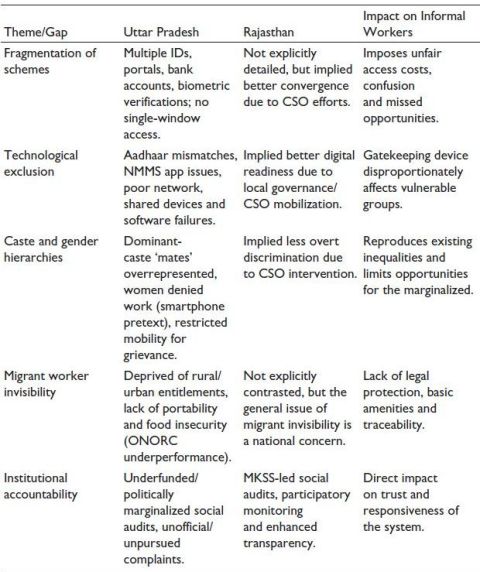
In conclusion, the current strategy of the modern state regarding workers’ welfare and informal labour is socio-economically insufficient, technologically overwhelming and structurally divided. These weaknesses undermine the confidence of the community and continue the politics of invisibility, where the informal workers are often tallied, tracked, but hardly protected.
Conclusion
The informal employment regime in India is not a temporary event or a transitional stage; it is an institutionalized and established fact that has been formed over decades of policy ambiguity, disjointed welfare planning and structural inequalities. Although many welfare programmes like MGNREGA, e-SHRAM and Ayushman Bharat have been implemented, the informal workforce is still mostly left out, which can be explained by the poor implementation, low awareness and insufficient institutional responsiveness. The excessive dependence on technological solutions has also contributed to the exclusion, which has led to a data-rich but delivery-poor system. A substantive change requires the breaking down of the existing fragmented, top-down system and the implementation of a universal social protection floor that ensures basic income security, healthcare, housing and nutrition to everyone.
The next imperative steps involve fortification of grassroots governance, protection of benefit portability of migrant workers and the creation of gender sensitive and rights-based welfare institutions. The decentralization of civil society organizations, by granting them legal power, financial independence and immunity against political pressure, is also critical in promoting accountability.
Finally, these reforms require long-term political commitment, institutional capacity-building and inclusive decision-making to be successful. The experience of Rajasthan and Uttar Pradesh shows that local responsiveness, administrative integrity and participatory social audits can collectively transform welfare delivery, making social protection equitable and sustainable.
Declaration of Conflicting Interests
The author declared no potential conflicts of interest with respect to the research, authorship and/or publication of this article.
Funding
The author received no financial support for the research, authorship and/or publication of this article.
Agarwal, S., Mohanty, D., & Choudhury, R. (2020). Portability of social protection for migrant workers in India: A policy brief. International Labour Organization.
Bhan, G., Jana, A., & Harish, S. (2020). The urban employment guarantee and the right to the city. Centre for Policy Research.
Bhattacharya, M. (2019). Social protection and the informal economy in India. Social Policy & Administration, 53(7), 950–967.
Breman, J. (2013). At work in the informal economy of India: A perspective from the bottom up. Oxford University Press.
Chen, M. A. (2012). The informal economy: Definitions, theories and policies [WIEGO Working Paper No. 1].
Deshpande, A. (2020). The grammar caste: Economic discrimination in contemporary India. Oxford University Press.
Deshingkar, P., & Akter, S. (2009). Migration and human development in India. UNDP Human Development Research Paper 2009/13.
Drèze, J., & Oldiges, C. (2022). Technological disempowerment in MGNREGA: A report from the ground. Economic & Political Weekly, 57(45), 27–31.
Dreze, J., & Sen, A. (2013). An uncertain glory: India and its contradictions. Princeton University Press.
Ghosh, J. (2020). The informal sector in India: A diagnosis of vulnerabilities and an agenda for policy. Journal of Agrarian Change, 20(3), 435–458.
Gupta, S., & Iyer, R. (2020). Digital governance and social protection in rural India. Economic & Political Weekly, 55(41), 40–48.
Harriss-White, B. (2004). India working: Essays on economy and society. Cambridge University Press.
Herring, R. (2015). Labour and informal work in India: Policy and practice. Routledge India.
ILO. (2018). Women and men in the informal economy: A statistical picture. International Labour Organization.
International Labour Organization. (2021). World social protection report 2020–22: Social protection at the crossroads – In pursuit of a better future.
Jain, N., & Mor, N. (2021). Ayushman Bharat: Evaluating financial risk protection. Brookings India Policy Paper.
Kabeer, N. (2019). Social protection, citizenship and the informal economy: A gender perspective [IDS Working Paper 347, Institute of Development Studies].
LibTech India. (2021). Slow and unsteady: Status of NMMS and ABPS in MGNREGA. https://libtech.in
Mehta, P., & Singh, S. (2021). MGNREGA and rural employment: Evidence from Uttar Pradesh. Indian Journal of Labour Economics, 64(2), 201–218.
Ministry of Statistics and Programme Implementation. (2023). Periodic labour force survey annual report 2022–23. Government of India.
Mohanty, S., & Pati, R. (2020). Urban informal work and access to social protection in India. Journal of Social Policy, 49(4), 685–706.
Nair, K. (2023). Gender and the informal economy in India. Routledge.
National Commission for Enterprises in the Unorganised Sector. (2007). Report on conditions of work and promotion of livelihoods in the unorganised sector. Government of India.
NSSO. (2019). Employment and unemployment survey 2018–19. Ministry of Statistics & Programme Implementation, Government of India.
Patel, R., & Desai, S. (2018). Civil society and social audits in rural India. Economic & Political Weekly, 53(12), 34–42.
Ray, D., & Subramanian, S. (2020). India’s lockdown: An interim report. Economic & Political Weekly, 55(27), 20–23.
Reddy, V., & Sekher, T. V. (2017). Social protection for the informal workforce in India: Status and challenges. National Institute of Public Finance and Policy.
Roy, A. (2022). Digital governance and informal labour exclusion: An empirical study from rural India. Indian Journal of Labour Economics, 65(3), 629–642.
Roy, A., & Kumar, P. (2020). Digital tools in rural welfare schemes: Evidence from Rajasthan. Development Studies Journal, 58(2), 105–123.
Sen, A., & Dreze, J. (1995). India: Economic development and social opportunity. Oxford University Press.
Sinha, A., & Mehta, K. (2021). Financial inclusion and informal workers: Evidence from e-SHRAM. Journal of Financial Inclusion, 4(1), 15–29.
State of Working India. (2021). One year of COVID-19: Findings from the Azim Premji University COVID-19 livelihoods survey. Azim Premji University.
Taneja, P. (2022). Challenges of urban informal employment and governance. Urban Studies, 59(7), 1345–1362.
Venkatesh, S., & Reddy, R. (2019). Informal labour markets and technology access in India. Information Technologies & International Development, 15(3), 20–36.
World Bank. (2021). India: Social protection and labour market review.
