
Journal of Liberal Arts and Interdisciplinary Sciences


Navya1 and Ilika Mohan1
1Ashoka Centre for a People-centric Energy Transition (ACPET), Ashoka University, Sonepat, Haryana, India

This article is distributed under the terms of the Creative Commons Attribution-NonCommercial 4.0 License (https://creativecommons.org/licenses/by-nc/4.0/) which permits non-commercial use, reproduction and distribution of the work without further permission provided the original work is attributed as specified on the SAGE and Open Access page (https://us.sagepub.com/en-us/nam/open-access-at-sage).
The transport sector in India is expected to continue to grow over the coming decades, which has led to concerns regarding the sector’s energy needs and the resulting greenhouse gas emissions. Although measures such as the electrification of vehicles, improvements in fuel efficiency and a move to more energy-efficient modes of transport are widely regarded as important mitigation strategies, there has been less investigation into their combined effect on the sector’s energy demand and the trajectory of its greenhouse gas emissions. This case study looks at how these measures, when taken together, could reduce energy demand and greenhouse gas emissions from India’s transport sector by 2050 under two different future scenarios. The two scenarios are called Business-as-Usual, where current trends are assumed to continue till 2050, and Ambitious, where the identified interventions are adopted at a faster pace. The results show that at the same level of transport activity projected for both passengers and freight, the Ambitious scenario has 13% less energy demand and 30% lower greenhouse gas emissions in 2050 relative to the Business-as-Usual scenario. This highlights the necessity of timely and targeted measures in the sector to shape the future profile of the sector’s energy demand and emissions, in line with India’s development and climate goals.
India transport sector, energy demand, greenhouse gas emissions, scenario analysis, low emissions analysis platform model, low-carbon transport
Introduction
The transport sector is of vital importance to India’s economic development since it facilitates the movement of both people and goods throughout the country. It is also a major driver of the country’s energy demand and carbon dioxide emissions. In 2020, the transport sector consumed around 4 EJ of energy, accounting for around 19% of the country’s total final energy consumption (Council on Energy, Environment and Water [CEEW], 2022). Road transport contributed over 92% of the CO2 emissions from the transport sector, including both passenger and freight movement (CEEW, 2022). The heavy dependence of mobility in India on petroleum also suggests that the efforts to decarbonise the transport sector are closely linked to issues of energy security, local air quality and climate change mitigation (Dhar & Shukla, 2015). Decarbonising transport has been consistently identified as essential by means of vehicle electrification, improved fuel efficiency and modal shifting to more energy-efficient modes of transport (CEEW, 2022; Dhar & Shukla, 2015; International Council on Clean Transportation [ICCT], 2022; The Energy and Resources Institute, 2024). The present study looks at the combined effect of these measures on the future trajectory of transport energy demand and tailpipe greenhouse gas emissions when they are implemented together rather than being considered as separate actions. If transport demand is expected to keep rising, then any eventual reduction in emissions will ultimately have to come about through a decrease in the amount of energy needed to satisfy that same level of transport demand or activity that has been projected. Hence, policies which aim at reducing the total amount of energy required to meet the projected level of transport demand are of great importance in determining the sector’s future emissions path.
The study is concerned with the medium term and offers insights into the way in which policy measures can assist in reducing the growth of energy demand and of emissions from the sector in the context of India’s development and climate objectives.
The article uses India’s transport sector as an example in order to look at how scenario-based energy modelling can be applied in assessing the combined impact of low-carbon transport measures on future energy demand and greenhouse gas emissions. India is a suitable example since it has to deal with the twin problem of meeting the growing demand for passenger and freight mobility while at the same time aiming to achieve energy security and climate policy goals. By adopting this case study approach, the analysis can examine how various levels of ambition regarding transport-sector interventions influence the long-term energy and emissions trajectories without assuming that total transport activity will decrease.
Literature Review and Research Gap
A variety of modelling methods have been employed to examine India’s future requirements for transport energy and its emissions. Previous studies have associated increased income, greater vehicle ownership and higher levels of mobility with future energy use and CO2 emissions (Arora et al., 2011; Singh, 2006). Dhar and Shukla (2015), who used the ANSWER-MARKAL framework, demonstrated that a sustainable, low-carbon transport pathway involving changes in mobility, vehicle technologies and fuels can achieve significant energy-security, air-quality and CO2 co-benefits by 2050. These studies indicate that transport outcomes are influenced not just by the level of mobility demand but also by the manner in which that demand is met; this is in line with the Activity-Structure-Intensity-Fuel (ASIF) approach, which is commonly applied in transport-emissions analysis (Schipper et al., 2000; United Nations Framework Convention on Climate Change, 2018).
More up-to-date evaluations support this finding, employing different analytical approaches and defining different system boundaries. According to CEEW’s India Transport Energy Outlook, transport energy demand is expected to increase greatly by 2050, and the report points out the importance of electrification, changes in the fuel mix and the increasing role of aviation and freight in determining the long-term results (CEEW, 2022). The ICCT’s meta-study of India’s road transport models shows that the projections published by the various models differ significantly since their assumptions, scope and modelling structures are not the same (ICCT, 2022). TERI (2024) does likewise by identifying electrification, improved efficiency, public transport and a shift in freight modes as the key elements of a lower-carbon transport transition.
The literature thus offers strong evidence regarding the relevance of both individual and combined mitigation strategies, but it also indicates that the results of the models are highly sensitive to the assumptions and boundaries adopted. The particular contribution of this case study is not to make a specific forecast about the future of transport in India. Rather, it makes use of a transparent scenario framework based on the low emissions analysis platform (LEAP) in which the passenger and freight activity underlying the scenarios remains unchanged. This approach enables an examination of how shifts in modal structure, vehicle technology and fuel efficiency can affect energy demand and tailpipe greenhouse gas emissions when the level of mobility required is kept the same. The study therefore addresses a more limited analytical gap in that it provides a directly comparable estimate of the cumulative impact of these interventions while keeping transport activity unchanged between the two scenarios.
Case Study Methodology
The case study makes use of LEAP, connecting top-down macroeconomic factors with a bottom-up depiction of different transport modes and technologies. In order to arrive at total passenger and freight transport demand for 2050, gross domestic product (GDP) and population growth are taken into account. Per-capita passenger mobility is subject to a saturation limit so that it does not continue to rise indefinitely as income increases. This approach has been shaped by the observed per-capita mobility levels in high-income economies and by previous transport modelling carried out in India, which links mobility growth to economic development but also allows for a slowing of that growth at higher income levels (Deep Decarbonization Pathways Project, 2015; Dhar & Shukla, 2015). A similar principle of saturation is applied to freight activity in order to avoid unconstrained long-term growth in transport intensity. The aim is to produce a reasonable trajectory of activity rather than to provide a precise forecast of future mobility.
The transport demand that is projected is then allocated among the major modes, vehicle categories and technologies. The calculation is based on the ASIF approach, which is commonly used in transport emissions analysis (Schipper et al., 2000; UNFCCC, 2018): activity refers to passenger-kilometres or tonne-kilometres; structure refers to how that activity is distributed among modes and vehicle categories; intensity is the amount of energy used per unit of activity; and fuel refers to the carbon intensity of the energy source. For each combination of mode, vehicle category and technology, energy use is calculated by multiplying the projected activity by the appropriate energy intensity. Fuel-specific emission factors are then used to estimate tailpipe emissions of carbon dioxide (CO₂), methane (CH₄) and nitrous oxide (N₂O), expressed in carbon dioxide-equivalent (CO₂e) terms. When all the combinations are aggregated, the national transport sector’s energy use and emissions pathways are obtained.
The time span covered by the model is from 2020 to 2050, with 2020 being taken as the base year since it is the most recent year for which the model could be consistently filled in with transport activity and energy data. 2050 is chosen as the end year because it offers a mid-century timeframe that is long enough for gradual changes in vehicle stocks, fuel efficiency and modal shares to become apparent, while still being relevant to long-term energy and climate planning. The underlying projections of passenger and freight activity are the same in both scenarios, so that any differences in the results are due to the interventions that are modelled and not to assumed reductions in mobility demand.
Model Boundary Conditions and Scientific Rationale
The model uses a national boundary that includes road, rail and domestic aviation as parts of the transport sector. International aviation is left out since its activities and emissions go beyond the borders of the domestic system and are usually accounted for separately in both national and international accounting systems. Water transport is not included because there were no available data on activity, modal share and energy intensity that were consistent enough to allow integration at the same level of detail as for road, rail and aviation. Metro systems are not treated as a separate mode and are therefore outside the scope of the current model. While these exclusions ensure that the model remains internally consistent, the results must be understood as showing possible developments for the transport modes that are included rather than as a full account of all transport activities in India.
The emissions boundary consists of direct tailpipe emissions of CO₂, CH₄ and N₂O, expressed in CO₂e terms (i.e., tank-to-wheel). As a result, electricity is considered to have zero direct vehicle emissions, whereas the emissions associated with electricity generation, fuel production, vehicle manufacturing and battery production are not included within the scope of the study. This approach has been chosen since the aim of the study is to examine the impact of transport-sector technologies, the pattern of modes of transport and efficiency on direct energy use and vehicle emissions. It must not be regarded as a life-cycle assessment; the effects of decarbonising the electricity sector are discussed as a significant limitation. Moreover, fixed and variable costs are omitted since the model is being used in this context as a scenario-accounting framework and not as a least-cost optimisation model.
The decision to keep the total level of transport activity the same in both the Business-as-Usual (BAU) and Ambitious scenarios is itself an intentional analytical limit. It establishes a controlled comparison that enables the effects of electrification, improvements in fuel efficiency and changes in mode of transport to be seen for the same mobility service. Thus, it prevents the effects of technological and efficiency changes from being mixed up with assumptions regarding reduced demand and makes it clearer where the difference between the scenarios comes from.
Figure 1 illustrates the hierarchical structure of the transport model, displaying the way in which the modes, sub-modes, and vehicle types are classified within the transport sector.
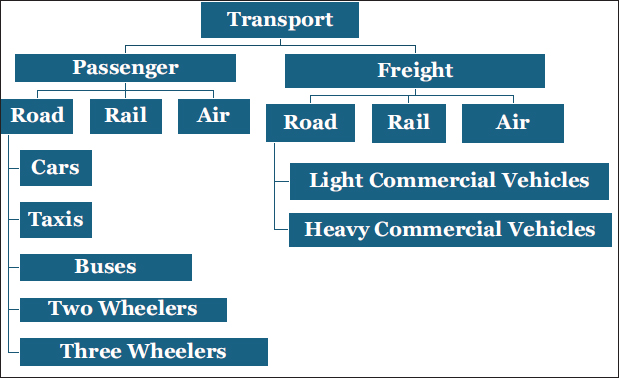
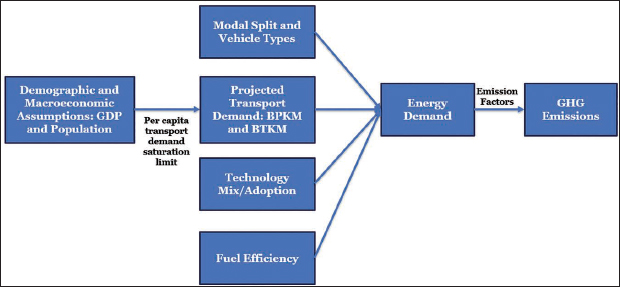
Figure 2 illustrates the way in which the calculations in LEAP are carried out, displaying the relationships between the main inputs (such as GDP, population, modal split and fuel efficiency) and the outputs (energy demand and greenhouse gas (GHG) emissions).
Scenario Design for the India Transport Case Study
In order to examine the effect of different levels of ambition in interventions in the transport sector on energy demand and emissions by 2050, two scenarios are developed.
Business-as-Usual
The BAU is based on the assumption that the present trends and policies will persist until 2050; road transport will continue to play a dominant role, fuel efficiency will improve only slowly and cleaner technologies such as electric vehicles will spread at a comparatively slower rate. It is meant to serve as a continuation pathway and not as a counterfactual in the absence of any policy action.
Ambitious
The ambitious scenario supposes a rapid electrification of vehicles, a shift in travel patterns towards more energy-efficient modes like rail and buses and greater improvements in fuel efficiency while maintaining the expected level of transport demand. These are measures that have been flagged time and again in studies and policy evaluations on India (CEEW, 2022; Dhar & Shukla, 2015; TERI, 2024). The aim here is to estimate the total effect of a more ambitious approach rather than to replicate any specific existing policy pathway. The underlying projections of transport demand, expressed in passenger-kilometres and tonne-kilometres, are identical in both scenarios, so that the difference in energy demand results from the effect of the interventions on the sector’s energy requirements and not from any reduction in transport demand.
Case Study Results
Transport Energy Demand
Figure 3 shows the total transport energy demand under the two scenarios. In the case of the BAU pathway, energy demand rises from around 4.6 EJ in 2020 to approximately 16.2 EJ by 2050. This more than threefold increase is in line with the general literature indicating that India’s transport energy requirement is likely to increase significantly as passenger and freight activity goes up, even if technologies become more efficient (CEEW, 2022).
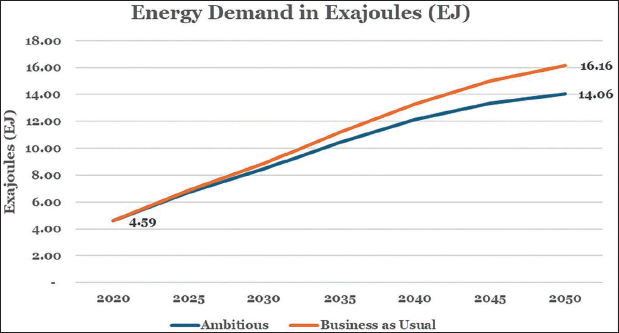
In the Ambitious scenario, the total demand for transport energy reaches about 14.1 EJ by 2050, which is roughly 13% less than the figure in the BAU case. Since transport activity remains the same across the scenarios, the difference is due to changes in how mobility is provided. This includes greater dependence on more energy-efficient modes, enhanced vehicle efficiency and a greater share of electric technologies. This finding is in line with previous studies carried out in India, which have found efficiency, electrification and structural change in the transport sector to be key factors for reducing final energy use (CEEW, 2022; Dhar & Shukla, 2015; TERI, 2024).
The distinction is clearer after the mid-2030s, which is due to the step-by-step introduction of the various interventions. Even though absolute energy demand continues to increase in the Ambitious scenario, the rate of this growth is clearly reduced as a result of the combined effect of the more ambitious interventions included in that scenario compared with those in the BAU.
Transport Sector Greenhouse Gas Emissions
The greenhouse gas emissions trajectories are shown in Figure 4; under the BAU, emissions rise from 325 MtCO₂e in 2020 to more than 1,060 MtCO₂e by 2050, which is comparable to the growth trajectory of energy demand in that scenario.
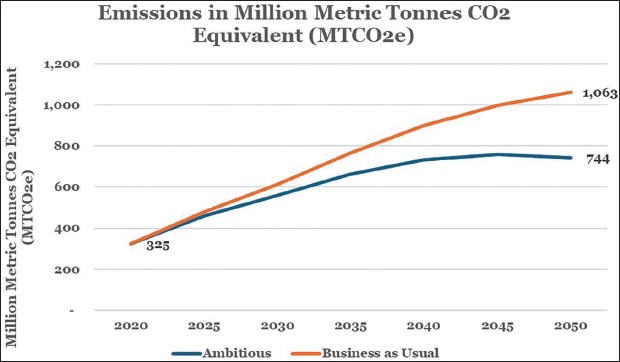
In the Ambitious scenario, the level of emissions in 2050 is considerably less than that in the BAU. By 2050, emissions in this scenario reach about 744 MtCO₂e, which is nearly 30% below the level in the BAU. This decrease is due to the lower energy consumption that is projected for the Ambitious scenario as compared to the BAU.
The fact that emissions have been reduced without having to assume a decrease in either passenger or freight activity shows that the model is able to illustrate how mobility services can be decoupled from direct energy use and tailpipe emissions as a result of changes in structure, intensity and fuel. This interpretation is in line with the ASIF approach employed in transport analysis, since it is possible for emissions to decline compared to a reference scenario even if activity is still increasing (Schipper et al., 2000; UNFCCC, 2018).
In the Ambitious scenario, emissions reach their peak around 2045 before falling, even though energy demand continues to rise at a slower rate.
The portion of the overall reduction in emissions in relation to the decrease in energy demand is also due to the study’s definition of the tailpipe emissions boundary. Although electricity use rises in the Ambitious scenario, electric vehicles are given zero direct tailpipe greenhouse gas emissions at the point of use. It therefore follows that the 30% reduction must be understood as a reduction in transport sector tailpipe greenhouse gas emissions, expressed in CO₂e, not as a life-cycle emissions reduction. Life-cycle assessments that have been published show that the climate benefits of electrification also depend on the carbon intensity of electricity generation and of vehicle and battery production (ICCT, 2024).
Cross-comparison with Other Modelling Approaches
In order to determine if the model generates results that fall within the wide range found in previously published studies on transport in India, a directional cross-comparison was carried out using the road transport figures given in the ICCT (2022) meta-study and the CEEW (2022) report. This does not constitute a one-to-one validation since the models being compared have different system boundaries, activity assumptions, policy settings and modelling structures. Some of them are optimisation or integrated-assessment models, while the current LEAP-based application is a bottom-up scenario-accounting model. The purpose of the comparison is therefore to check the plausibility of the results and to indicate where the LEAP-based results lie among the various published outcomes.
The LEAP-based estimate for road transport is within the range of the results from various published models rather than being located at the extremes of the comparison. This serves as a useful consistency check, and at the same time the large variation between the studies shows that scenario results should be regarded as conditional pathways rather than as forecasts. The ICCT (2022) meta-study likewise finds that road-transport projections can differ greatly between modelling exercises since their assumptions and scope are not the same.
Discussion and Policy Implications
The findings from the scenarios support a key conclusion in the literature on transport and decarbonisation: an increase in mobility does not necessarily mean that energy use and emissions should rise in proportion. In the Ambitious scenario, in 2050 the same level of passenger and freight activity is achieved with 13% less energy and approximately 30% fewer tailpipe greenhouse gas emissions. The fact that the reduction in emissions is greater than the reduction in energy demand is due to both improved energy efficiency and a shift towards electricity, which has no direct vehicle emissions within the boundaries defined. Just as Dhar and Shukla (2015) found that combining changes in mobility patterns, vehicle technologies and fuels can lead to significant CO2 emissions reductions and energy-security advantages, so too does CEEW (2022) point out that electrification and changes in the fuel mix are the main factors affecting India’s long-term transport energy prospects.
It is also important to consider other modelling methods when interpreting the absolute values. According to the ICCT (2022) meta-study, there is a wide variation in the road-transport projections for India since the modelling assumptions and the scope differ. The LEAP-based road-energy estimate is within this published range, which lends support to the plausibility of the model’s trajectory but at the same time warns against viewing the 2050 figures as forecasts. The more reliable insight is the difference between the two scenarios within the same model, since both scenarios rely on the same activity projection and model structure and differ primarily in the level of ambition given to modal shares, technology adoption and efficiency improvements.
The difference between the scenarios increases after the mid-2030s, showing that transport transitions are cumulative. Since vehicle stocks are replaced slowly, infrastructure development takes time and changes in mode of transport require continuous investment rather than just one-off policy measures. This is in line with the policy literature, which stresses the need for charging infrastructure, vehicle-efficiency standards, increased investment in public transport and changes to the freight system as part of a wider transport transition (TERI, 2024). As a result, the model implies that delaying action would reduce the time during which these measures can affect the stock and activity mix in 2050.
The consequences also extend beyond the direct reduction of greenhouse gas emissions. Since final energy demand is lower and the use of petrol and diesel is reduced, dependence on imported petroleum can be lessened, thus connecting improvements in transport efficiency with energy-security goals (Dhar & Shukla, 2015). Moreover, increased use of public transport and cleaner vehicle technologies can help decrease exposure to local pollutants, even though the air-pollution effects are not quantified in this study. These additional benefits reinforce the argument for coordinated action as a policy measure, but they should be examined explicitly in future extensions rather than being deduced from the current greenhouse gas emissions results.
It therefore makes sense to concentrate on portfolios rather than on any one technology; electrification reduces direct vehicle emissions, efficiency gains lower the energy needed per unit of activity, and changes in mode of transport decrease the proportion of activity carried out by modes that are relatively energy-intensive. The scenario results illustrate the overall effect of these measures, since they do not provide an estimate of the marginal contribution of each measure separately. A useful next step would be to carry out a decomposition or sensitivity analysis in which electrification, modal shift and efficiency are varied independently in order to determine their individual and interactive effects.
Limitations
The model does not include the fixed and variable costs associated with various transport methods, the integration of biofuels, water transport, metro transport and international aviation. As a result, it is not carrying out a least-cost optimisation and so cannot identify which transport method is economically optimal. Furthermore, the emissions accounting only covers the direct tailpipe emissions of CO₂, CH₄ and N₂O, expressed in CO₂e terms; it does not take into account the emissions resulting from electricity generation, fuel production, vehicle manufacturing and battery production. This point is especially significant when interpreting the emissions advantages of electrification since the life-cycle impacts depend on the carbon intensity of the electricity and on the emissions from upstream vehicle and battery production (ICCT, 2024).
The outcomes are scenario-dependent pathways and not precise forecasts of future demand and emissions. They depend on the assumptions made regarding mobility growth, saturation limits, modal shares, technology adoption and fuel efficiency. This uncertainty is shown by the cross-model comparison: even when the indicators are broadly similar, the various models produce a wide range of results (ICCT, 2022). Future work should therefore involve a sensitivity analysis concerning the main assumptions and, where data are available, extend the scope to include life-cycle emissions, costs and other modes.
| Model/Study | 2020 Road Energy Demand (EJ) | 2050 Road Energy Demand (EJ) |
| CEEW/GCAM-based assessment | 3.50 | 12.13 |
| CSTEP | 5.25 | 13.54 |
| PNNL | 3.50 | 10.52 |
| IRADe | 4.58 | 32.08 |
| TERI | 5.07 | 21.08 |
| ICCT synthesis/reference | 4.04 | 14.67 |
| LEAP (road transport only) | 4.24 | 12.52 |
Source: The values have been compiled by CEEW (2022), ICCT (2022) and the LEAP-based transport model; since the various studies have different scopes and assumptions, the values are not directly comparable and should be regarded as lying within a plausible range.
Note: CEEW: Council on Energy, Environment and Water; CSTEP: Center for Study of Science, Technology and Policy; GCAM: Global Change Analysis Model; ICCT: International Council on Clean Transportation; IRADe: Integrated Research and Action for Development; LEAP: Low emissions analysis platform; PNNL: Pacific Northwest National Laboratory; TERI: The Energy and Resources Institute.
Conclusion
This case study shows the way in which a LEAP-based scenario framework can be applied in order to look at the combined impact of electrification, improvements in fuel efficiency and changes in mode of transport on India’s transport energy demand and its tailpipe greenhouse gas emissions. For the same projected levels of passenger and freight activity, the Ambitious scenario leads to approximately 13% less energy demand and about 30% fewer tailpipe greenhouse gas emissions by 2050 as compared with the BAU. The findings thus indicate that a significant portion of mitigation within the transport sector can result from changing the way in which mobility is provided, even if the basic level of mobility demand is not reduced.
These results are in agreement with the existing literature, which regards technology transition, efficiency gains and changes in transport modes as the main strategies for decarbonising transport (CEEW, 2022; Dhar & Shukla, 2015; TERI, 2024). Yet, when the present study is compared with other modelling studies carried out in India, it becomes clear that the absolute long-term forecasts differ greatly among the various modelling methods. The value therefore of the current model lies in the fact that it should be seen as a controlled scenario comparison and not as a forecast: since passenger and freight activity is kept constant in the different scenarios, the cumulative impact of changes in structure, intensity and fuel on energy use and direct emissions is isolated.
By offering a clear and comprehensive evaluation of these interventions in the contexts of road, rail and domestic aviation within one coherent framework, the model fills the research gap noted in the literature review. It also clearly defines the analytical boundaries: international aviation, water and metro transport, costs, biofuel pathways and upstream or life-cycle emissions are not included within the present scope. Setting out these boundaries helps to make clear what the reported reductions entail and where additional research is needed.
From a policy point of view, the findings indicate that it is better to take early and coordinated action using a range of different measures than to depend on a single technology. Measures such as speeding up electrification, maintaining continuous improvements in fuel efficiency, strengthening public and rail transport and shifting freight from one mode to another can help to slow the growth in transport energy demand and tailpipe emissions while at the same time promoting energy security and achieving climate goals. Future work in this area should examine how sensitive the results are to each individual assumption, isolate the contribution of each mitigation measure and include life-cycle emissions and economic costs where sufficient data are available.
Abbreviations
AMB: Ambitious scenario; BAU: Business-as-Usual scenario; CO2: Carbon dioxide; EJ: Exajoule; EV: Electric vehicle; GDP: Gross domestic product; GHG: Greenhouse gas; LEAP: Low emissions analysis platform; Mt: Million tonnes; CH₄: Methane; CO₂e: Carbon dioxide equivalent; N₂O: Nitrous oxide.
Author Contributions
Navya: Conceptualisation, methodology, modelling, analysis, writing and revision.
Ilika Mohan: Conceptualisation, supervision, methodology review and manuscript review.
Data Availability Statement
The data used in this study were drawn from publicly available sources and model-based scenario assumptions. Further details can be made available by the corresponding author upon reasonable request.
The authors declare no potential conflicts of interest with respect to the research, authorship and/or publication of this article.
Ethics Statement
This study does not involve human participants, animal subjects or primary survey data.
The authors received no financial support for the research, authorship and/or publication of this article.
Arora S., Vyas A., & Johnson L. R. (2011). Projections of highway vehicle population, energy demand, and CO2 emissions in India to 2040. Natural Resources Forum, 35(1), 49–62. https://doi.org/10.1111/j.1477–8947.2011.01341.x
Council on Energy, Environment and Water. (2022). India transport energy outlook: Decarbonising energy use in India’s transport sector. https://www.ceew.in/sites/default/files/ceew–research–transport–energy–use–carbon–emissions–decarbonisation.pdf
Deep Decarbonization Pathways Project. (2015). Pathways to deep decarbonization in the United Kingdom. IDDRI, Sustainable Development Solutions Network, & UCL Energy Institute. https://www.iddri.org/sites/default/files/old/Publications/UK_DDPP_report.pdf
Dhar S., & Shukla P. R. (2015). Low carbon scenarios for transport in India: Co–benefits analysis. Energy Policy, 81, 186–198. https://doi.org/10.1016/j.enpol.2014.11.026
International Council on Clean Transportation (ICCT). (2022). Decarbonizing India’s road transport: A meta–analysis of road transport emissions models. https://theicct.org/wp–content/uploads/2022/05/Meta–study–India–transport_final.pdf
ICCT. (2024). A comparison of the life–cycle greenhouse gas emissions of diesel, electric and hydrogen heavy–duty vehicles in India. https://theicct.org/wp–content/uploads/2024/05/ID–86–%E2%80%93–LCA–HDVs–India_final3.pdf
Schipper L., Marie–Lilliu C., & Gorham R. (2000). Transportation and CO2 emissions: Flexing the link—A path for the World Bank. World Bank. https://documents1.worldbank.org/curated/en/826921468766156728/pdf/Transportation–and–CO2–emissions–flexing–the–link–a–path–for–the–World–Bank.pdf
Singh S. K. (2006). Future mobility in India: Implications for energy demand and CO2 emission. Transport Policy, 13(5), 398–412. https://doi.org/10.1016/j.tranpol.2006.03.001
The Energy and Resources Institute. (2024). Roadmap for India’s energy transition in the transport sector. https://teriin.org/sites/default/files/2024–11/Roadmap%20for%20India%20Energy%20Transition_FINAL%20REPORT.pdf
United Nations Framework Convention on Climate Change. (2018). Compendium on GHG baselines and monitoring—Passenger and freight transport. https://unfccc.int/sites/default/files/resource/Transport_0.pdf
