
Journal of Liberal Arts and Interdisciplinary Sciences

1Ashoka Centre for a People-Centric Energy Transition (ACPET), Okhla Industrial Estate, New Delhi, India

Creative Commons Non Commercial CC BY-NC: This article is distributed under the terms of the Creative Commons Attribution-NonCommercial 4.0 License (http://www.creativecommons.org/licenses/by-nc/4.0/) which permits non-Commercial use, reproduction and distribution of the work without further permission provided the original work is attributed.
The livelihoods, economies, and landscapes in mining regions are significantly impacted by the closure and transition of coal mines. Recent policy developments in India indicate a shift toward more inclusive post-mining futures. However, community participation is still limited in practice, and decision-support tools continue to favor technical and expert-driven approaches. Building on insights from the existing literature on post-mining land use (PMLU) assessment approaches, this study suggests a three-phase, people-centric PMLU assessment framework intended to bridge the gap between spatial decision analysis and participatory engagement. The approach recommends (a) thorough site and stakeholder assessments to identify community needs; (b) social-ecological system mapping and causal-loop modeling to translate these priorities into possible land-use options; and (c) geographic information systems-multi-criteria decision analysis to assess the spatial suitability of shortlisted options based on expert-derived criteria. It preserves analytical rigor while emphasizing local knowledge and regional social-ecological dynamics to identify technically feasible, environmentally sound, and economically viable PMLUs, which also preserve sociocultural ties to the landscape.
Post-mining land use, geographic information systems-multi-criteria decision analysis, spatial decision-support, social-ecological systems
Introduction
As coal-dependent regions increasingly transition away from fossil fuels, questions about how to responsibly close and transform coal mines have gained considerable attention. India holds an estimated 378.21 billion tons of coal reserves as of April 2023, with Jharkhand, Odisha, and Chhattisgarh accounting for roughly 70% of these resources (Geological Survey of India, 2023). Coal remains central to India’s energy matrix, providing over 55% of primary energy and fueling approximately 74% of electricity generation (CEA, 2022), while supporting more than 7 million direct and indirect livelihoods (ILO, 2021). In the face of ambitious climate commitments, including a 47% reduction in emissions intensity by 2035 and net-zero emissions by 2070 (GoI, 2026), India confronts the urgent challenge of phasing out coal mining in a just and sustainable manner.
India’s 2025 mine closure guidelines, developed by the Ministry of Coal (MoC), demonstrate a significant interest in the environmental, socio-economic, and community-focused implications of selecting post-mining land uses (PMLUs). They emphasize that mines cannot be abandoned or backfilled alone, but must undergo a deliberate process of reclamation, regeneration, and ultimately repurposing to benefit affected communities (MoC, 2025). These closure stages require technical planning alongside a robust system of criteria and frameworks to assess if a site is environmentally stable, economically feasible, socially acceptable, and technically suitable for future use. Recognizing the multifunctionality of post-mining landscapes, the guidelines promote renewable energy projects, sustainable agriculture, eco-tourism, and social infrastructure development.
Despite having identified 299 mines for closure, only three have been formally closed in the last 16 years, indicating substantial delays that exacerbate social vulnerabilities and slow ecological restoration (CAG, 2023). Indeed, coal mining regions have been transformed into “monoculture societies,” and mine closures will not only cause significant unemployment among formal and informal mine workers but also significantly reduce the income of local businesses, force workers’ outmigration, and dampen local economic opportunities (Kime et al., 2023; Pai et al., 2026).
In this perspective, we speak to several considerations and challenges pertaining to effectively repurposing mines within the Indian context. First, we highlight the relative disconnect between highly technical, site-specific post-mining land management strategies that primarily focus on hazard mitigation and safety, and a growing interest in engaging stakeholders (including mining experts, decision makers, and communities) via participatory approaches and place-based analyzes. We respond to these gaps by introducing a multi-stage “people-centric” framework for assessing the suitability of coal mine repurposing projects in India that prioritizes community needs and is methodologically flexible.
Assessing the Suitability of Post-mining Land Uses: Methodologies and Limitations
The most commonly used research approach to assess the suitability of various PMLUs is multi-criteria decision analysis (MCDA), a structured approach to decision-making when conflicting economic, environmental, societal, technical, and esthetic objectives are involved (either by identifying a most preferred option, distinguishing between acceptable/unacceptable outcomes, or shortlisting and ranking options). MCDA has been widely used to develop stakeholder-informed suitability rankings of PMLUs (Demirkan et al., 2022; Eshun et al., 2018; Soltanmohammadi et al., 2010), while geographic information systems (GIS) have enabled the development of spatially explicit suitability assessments (Giri et al., 2025; O’Donnell et al., 2024), including in the Indian context (Bhushan et al., 2025). Some studies incorporate expert judgment into geospatial suitability models (U.S. Geological Survey, 2024) or combine stakeholder-derived weights with GIS-based criteria (Arratia-Solar et al., 2022). However, many PMLU studies start with pre-structured decision problems, which restricts transferability and significant community involvement (Amaro et al., 2022). To address this, recent approaches emphasize co-design, early-stage stakeholder participation, and regionally aware assessments, indicating a shift toward more flexible, people-centered PMLU decision-making (Simpson et al., 2025; Svobodova et al., 2021).
A growing body of research prioritizes community engagement during mine closure and repurposing, primarily through participatory methodologies rooted in the social sciences (Bainton & Holcombe, 2018). They have found that stakeholder interviews/panels effectively surface diverse viewpoints and identify conflicts, though simpler metrics like consultation frequency, favored by mining companies, fail to address fairness, trust, and community ownership (Everingham et al., 2018, 2020). Furthermore, formal and adversarial consultation procedures, strict deadlines, and the prioritization of techno-scientific variables challenge the inclusivity of community impact assessments and highlight a need to epistemically prioritize communities’ experiential and cultural knowledge (Rodon et al., 2025; Worden et al., 2024). In India, resources like the MoC and the Coal Controller Organization’s R.E.C.L.A.I.M and L.I.V.E.S frameworks emphasize the centrality of community engagement, post-closure social development, ecosystem rehabilitation, and sustainability (Coal Controller Organization, 2025a, 2025b; Ministry of Coal, 2025). They advocate creating repurposing plans well before the cessation of mining activities, including conducting comprehensive assessments of land, ecology, and the socio-economic profiles of neighboring communities.
Despite numerous calls for multi-stage community involvement in mine closure and repurposing processes in the academic and gray literature, it remains relatively uncommon in practice (Measham et al., 2024; Schneider et al., 2023; Unger et al., 2020). Arratia-Solar et al.’s (2022) review found 22 studies that applied MCDA techniques to PMLU planning, of which two involved communities (and neither included a GIS analysis). We similarly found no GIS–MCDA studies that integrate community input into PMLU identification, criteria development, or model weighting. This reflects broader global trends: only 23% of governments report high levels of community participation in closure planning, while 37% report none (Stevens & Brock, 2021). Where stakeholder perspectives are included, expert and government views overwhelmingly dominate, with communities typically consulted only at the final stage.
There is also a need for place-based research to identify mutually beneficial outcomes, as geographic, cultural, and stakeholder specificities vary widely and cannot be addressed by a generic, top-down approach to identifying PMLUs. For instance, mine closure practices have been codified in high income, Global North contexts (e.g., Germany, USA, Australia), where the emphasis was on returning to the “natural” pre-mining land cover (Limpitlaw & Briel, 2014). In lower- and middle-income countries like India, however, coal mining has an immense impact on neighboring communities’ direct/indirect employment and access to free/low-cost fuel and social services (e.g., schools, medicine) (Banerjee et al., 2024; Mitra et al., 2024). When a mine closes, a regional-scale transition is experienced, and effective planning thus requires understanding the ecological and socio-economic dynamics of the surrounding areas (Côte et al., 2022). Assessing the suitability of PMLUs for mine sites in India thus necessitates an understanding of the landscape at the mine site and the potential knock-on effects across the region.
A People-centric Post-mining Land Use Assessment Framework
Mine closure affects every dimension of community life: livelihoods, housing, health, environment, and social cohesion (Ronyastra et al., 2023). The long-term resilience of post-mining regions depends on establishing positive feedback loops that link environmental recovery with human well-being (Cao & Tang, 2025). This underscores the need to move beyond narrow, hazard-mitigation or engineering-centered approaches (Huang et al., 2022) toward a social-ecological systems (SES) paradigm that captures the coupled dynamics of people and landscapes.
The SES framework conceptualizes post-mining areas as integrated systems of social, economic, cultural, and ecological components. Building on Ostrom’s (2009) foundational work, Cao and Tang (2025) propose a post-mining SES framework that highlights the importance of identifying system components, hierarchical levels, and cross-scale interactions. Core SES concepts, such as resilience, may be mobilized to understand how effectively a post-mining area can absorb the multifaceted impacts of mine closure (e.g., economic outmigration, social instability, land degradation). The related concept of vulnerability (a combination of exposure, sensitivity, and adaptive capacity to changes) is also crucial to effectively managing the intense risks and changes associated with mine closure (Miller et al., 2010). Agrawal et al. (2024) operationalized this definition to develop a coal vulnerability index to understand how the burden of coal phase-out is distributed across districts in India. While the authors did not work within an explicitly SES framework, their work demonstrates that SES-related concepts are already being used in the Indian post-mining context.
In response to the global research literature on PMLUs and the most recent policy developments in India on mine closure, we propose a people-centric approach synthesizing both bottom-up and top-down methods to assess the suitability of mine repurposing projects in the Indian context. The driving goals of our approach are to:
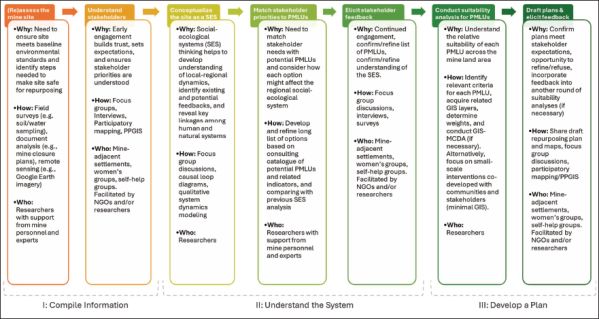
This strategy is in line with suggestions that mine closure procedures give priority to long-term societal benefits, community and regional development goals, and environmental protection (Rosa et al., 2018). We structure the approach into three overarching phases: information compilation, system understanding, and PMLU suitability analysis and planning, within which we recommend certain sub-steps and associated methods (see Figure 1).
Figure 1. Three Phases of a People-centric Approach to Coal Mine Repurposing
Phase I: Compile Information
A fundamental prerequisite for any repurposing project is ensuring that the mine site is in a safe, stable condition, as failure to do so could jeopardize any future developments on the site (Ronyastra et al., 2023). Before a closed coal mine can be transformed into a new productive use, it must first meet baseline environmental standards, including soil health, terrain stability, contamination risk, and surface structure. The foundational criteria associated with reclamation and remediation thus determine these baseline standards and assess whether repurposing is feasible in the first place. This is especially important in India, where many mines being considered for repurposing today were closed decades prior. Essential steps at this stage include analyzing mine closure plans to identify mine characteristics, year of closure, remediation or rehabilitation processes undertaken, and the presence of settlements in the area. Fieldwork (e.g., soil/water/geotechnical surveys) may also need to be conducted to assess the state of the mine lands, including safety hazards, slope stability, water, and soil quality. Although this step is mostly expert-driven (geotechnical surveys, soil and water testing, site inspections), incorporating local knowledge is beneficial, particularly in places where communities have long interacted with post-closure landscapes. The availability of land for large-scale PMLUs is impacted by settlements located within mine boundaries, which may be included in closure plans, where applicable.
Eliciting the needs, goals, and priorities of impacted communities and regional stakeholders is the other focus of Phase I. This process should closely involve personnel from local non-governmental organizations and universities in addition to collaborating with mining staff from the associated subsidiary. Activities such as focus groups, participatory mapping, visioning exercises, participatory GIS techniques, and evaluations of development plans at the district and village levels can be conducted as part of frameworks such as participatory rural appraisal, which prioritizes participatory data collection processes and community ownership and sharing of knowledge (Chambers, 1994). Crucially, communities should not be viewed as homogeneous; conscious efforts are required to include voices from women, marginalized groups, and people with different social backgrounds. This process should also seek to incorporate inputs from regional decision makers (e.g., District Collectors), miners, non-governmental organizations, and academics. These perspectives help to align PMLU options with existing plans and institutional realities, while simultaneously capturing regional social-ecological interactions.
Phase II: Understand the System and Build a Shortlist
Phase II focuses on matching stakeholder priorities with technically feasible PMLUs. Doing this effectively requires assessing how each proposed PMLU might fit within and affect the existing SES that the mine site is embedded in. Visualizing the structure of the SES helps to test and clarify system understanding and identify potential feedback (both positive and negative). A useful method for visualizing and examining feedback in intricate social-ecological contexts is qualitative system dynamics modeling, particularly through the use of causal loop diagrams (CLDs) (Egerer et al., 2021). CLDs identify reinforcing and balancing loops, map variables and their causal relationships, and show how system behaviors change over time. By co-creating CLDs, stakeholders and researchers can identify leverage points, and develop a common understanding of the dynamics of the mine site and its surrounding areas, articulate the SES-specific complexities of assigning PMLUs, and identify cause-and-effect dynamics between stakeholders and the mining landscape. While co-creation with stakeholders is ideal, resource or time constraints may necessitate researchers working alone to collate and synthesize the information collected during Phase I.
Once consensus has been reached on the CLD and its representation of the SES, the next step is to develop a long list of potential PMLUs that match the priorities identified by the communities. This should be refined to a shortlist through a screening process, based on existing knowledge of the surrounding landscape. Key components of this screening process include reexamining constraints (such as hydrology, topography, and energy resources) and determining how each PMLU might affect the SES.
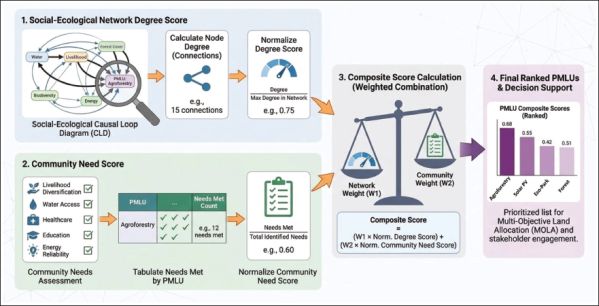
The next step is to translate the qualitative insights from the systems thinking exercises and community engagement into quantitative scores for prioritizing the PMLU selection (Figure 2). The CLD encodes causal connections between variables and can therefore be treated as a directed social-ecological network, wherein the simplest proxy for “importance” is the degree (number of connected links) (Chignell, 2023). Both qualitative and quantitative network analysis have a long history of use in sustainability science, and network metrics are widely applied to help conceptualize and analyze key SES concepts (Bodin et al., 2019; Sayles et al., 2019). In the context of coal-mine repurposing, for example, a higher total degree (as well as other metrics like betweenness) signals a PMLU that is both fed by many variables and feeds many others (i.e., a “lever” in the system).
Calculating the network?centrality weights (degree?based) tells us how structurally important each PMLU is in the network, but it does not tell us how well each PMLU meets community needs. To make the ranking responsive to what communities actually want, a community-need score can be calculated, simply by listing out the needs as stated in community assessment reports or interviews and counting the number of needs met by each PMLU. These weights are purely demand?driven: they reflect how many distinct community?stated priorities each PMLU can address, ignoring any technical feasibility or cost considerations.
Combining the community need score with the earlier network?centrality weights (or any cost?benefit analysis) can produce a balanced composite priority index that respects both what the system needs to change and what the community actually wants. This can then be used to create a final shortlist of ranked PMLUs and even serve as weights in subsequent GIS–MCDA procedures. Prior to moving to Phase III, the final CLD and ranked list of PMLUs should be shared with the involved communities and other regional stakeholders to corroborate the understanding of the system, reaffirm consent and transparent decision-making, and reduce the chances of later conflict.
Figure 2. Combining Network-based and Community-based Insights for Post-mining Land Use (PMLU) Scoring.
Phase III: Develop a Site-specific Repurposing Plan
The final phase is to identify the most suitable areas of the mine site for each PMLU on the stakeholder-approved shortlist, and to use this to develop a repurposing plan. The first step involves conducting a suitability analysis of each shortlisted PMLU based on multiple biophysical and social criteria. The level of complexity of the suitability analysis should match the specific context of the mine site in question. For example, mine sites with smaller areas and dense populations are likely a better fit for low-tech approaches (i.e., small-scale interventions co-developed with communities and limited use of GIS). Sites with larger areas and limited human settlements would allow for a more complex, data-intensive GIS–MCDA. In cases where the shortlist consists of only one or two PMLUs, it may be sufficient to conduct a GIS–MCDA for each PMLU and manually resolve spatial conflicts in any areas where both PMLUs are highly suitable. In cases with more than two PMLUs, the GIS–MCDA may benefit from the use of conflict resolution algorithms such as multi-objective land allocation (MOLA) (Eastman et al., 1993); MOLA can assign equal weights to each PMLU or incorporate custom weights such as the composite scores derived in Phase II, further connecting insights gained in earlier phases into the suitability analysis. Regardless, the GIS–MCDA should follow standard processes, tailored to the specificities of the mine site in question. Resulting draft maps and plans should be returned to communities and stakeholders for validation, ensuring transparency, informed consent, and the opportunity to revise or reject proposals. This final opportunity for feedback strengthens legitimacy and reduces conflict before proceeding to planning or implementation.
Conclusion
This perspective has discussed the evolving policy landscape pertaining to mine closure and PMLUs, provided an overview of the main approaches used to assess the suitability of PMLUs, and proposed a people?centric framework for repurposing India’s abandoned coal mines into sustainable, community?driven PMLUs. Although there is a robust research literature about the technical and scientific aspects of mine closure, socio-economic impact assessments remain uncommon, especially those involving consultations with communities in post-mining areas. A gap persists between grassroots, community?led initiatives and more technical or formalized processes of mine repurposing, and research from the social sciences remains notably scarce.
Our proposed “people-centric” framework for assessing the suitability of PMLUs aims to bridge this gap by integrating stakeholder engagement, spatial decision-support tools, and SES thinking. It seeks to overcome the disconnect between participatory, GIS, and MCDA approaches and guarantee that PMLU planning is not only analytically sound but also socially responsive and based on the priorities of impacted communities by directly incorporating community-driven inputs into the spatial decision-making process. The novelty of this approach lies in its use of SES and the explicit integration of participatory engagement with GIS–MCDA, bringing together two methodological streams that are typically applied in isolation. This enables the identification of coal mine PMLUs that are not only technically feasible, environmentally sound, and economically viable, but also deliver tangible livelihood benefits and preserve sociocultural ties to the landscape.
Declaration of Conflicting Interests
The authors declared no potential conflicts of interest regarding the research, authorship, and/or publication of this article.
Funding
The authors received no financial support for the research, authorship, and/or publication of this article.
Agrawal, K., Pathak, M., Jana, K., Unni, J., & Shukla, P. (2024). Just transition away from coal: Vulnerability analysis of coal districts in India. Energy Research & Social Science, 108, 103355. https://doi.org/10.1016/j.erss.2023.103355
Amaro, S. L., Barbosa, S., Ammerer, G., Bruno, A., Guimerà, J., Orfanoudakis, I., Ostr?ga, A., Mylona, E., Strydom, J., & Hitch, M. (2022). Multi-criteria decision analysis for evaluating transitional and post-mining options—An innovative perspective from the EIT ReviRIS project. Sustainability, 14(4), 2292.
Arratia-Solar, A., Svobodova, K., Lèbre, É., & Owen, J. R. (2022). Conceptual framework to assist in the decision-making process when planning for post-mining land-uses. The Extractive Industries and Society, 10, 101083. https://doi.org/10.1016/j.exis.2022.101083
Bainton, N., & Holcombe, S. (2018). A critical review of the social aspects of mine closure. Resources Policy, 59, 468–478. https://doi.org/10.1016/j.resourpol.2018.08.020
Banerjee, S., Satyam, A., Sah, P., & Mary, A. (2024). Sustainability framework for coal mines—Instituting a just transition plan for mine closure. iFOREST—International Forum for Environment, Sustainability & Technology. https://iforest.global/wp-content/uploads/2025/09/Sustainability-Framework-for-Coal-Mines.pdf
Bhushan, C., Banerjee, S., & Bissu, B. (2025). Regional just transition investment plan: Chandrapur-Nagpur-Yavatmal. iFOREST—International Forum for Environment, Sustainability & Technology. https://iforest.global/report/regional-just-transition-
investment-plan-chandrapur-nagpur-yavatmal/
Bodin, Ö., Alexander, S. M., Baggio, J., Barnes, M. L., Berardo, R., Cumming, G. S., Dee, L. E., Fischer, A. P., Fischer, M., Mancilla Garcia, M., Guerrero, A. M., Hileman, J., Ingold, K., Matous, P., Morrison, T. H., Nohrstedt, D., Pittman, J., Robins, G., & Sayles, J. S. (2019). Improving network approaches to the study of complex social–ecological interdependencies. Nature Sustainability, 1. https://doi.org/10.1038/s41893-019-0308-0
CAG. (2023). Report on performance audit of mine closure in India. Comptroller and Auditor General of India.
Cao, Z., & Tang, J. (2025). A framework for post-mining area restoration based on social-ecological system analysis. Science, Engineering and Technology Proceedings, 1, 47–59. https://doi.org/10.71222/2qptd371
CEA. (2022). Load generation balance report. Central Electricity Authority, Government of India.
Chambers, R. (1994). Participatory rural appraisal (PRA): Analysis of experience. World Development, 22(9), 1253–1268. https://doi.org/10.1016/0305-750X(94)90003-5
Chignell, S. M. (2023). A missing link? Network analysis as an empirical approach for critical physical geography. The Canadian Geographer/Le Géographe canadien, 67, 52–73. https://doi.org/10.1111/cag.12767
Coal Controller Organization. (2025a). Closure beyond compliance embracing L.I.V.E.S. for a sustainable future. Ministry of Coal, Government of India.
Coal Controller Organization. (2025b). RECLAIM: A community development framework. Ministry of Coal, Government of India. https://coal.gov.in/sites/default/files/2025-08/14-08-2025a-wn.pdf
Côte, C., Asmussen, P., & Gentle, C. (2022). Dynamically transforming environmental assessment through a shared analytics framework: Bowen Basin case study. University of Queensland. https://espace.library.uq.edu.au/view/UQ:1235185
Demirkan, C. P., Smith, N. M., & Duzgun, S. (2022). A quantitative sustainability assessment for mine closure and repurposing alternatives in Colorado, USA. Resources, 11(7), 66. https://doi.org/10.3390/resources11070066
Eastman, J. R., Toledano, J., Weigen, J., & Kyem, P. A. K. (1993). Participatory multi-objective decision-making in GIS. In Proceedings of the Eleventh International Symposium on Computer-Assisted Cartography (Auto-Carto 11) (pp. 33–42). Minneapolis, Minnesota, USA, October 30 – November 1, 1993. American Society for Photogrammetry and Remote Sensing (ASPRS).
Egerer, S., Cotera, R. V., Celliers, L., & Costa, M. M. (2021). A leverage points analysis of a qualitative system dynamics model for climate change adaptation in agriculture. Agricultural Systems, 189, 103052. https://doi.org/10.1016/j.agsy.2021.103052
Eshun, P. A., Davies-Ocloo, E. A., & Amegbey, N. (2018). Multi-criteria decision analysis approach to mine closure planning—A case study. Environment and Natural Resources Research, 8(2), 100. https://doi.org/10.5539/enrr.v8n2p100
Everingham, J., MacKenzie, S., Svobodova, K., & Witt, K. (2020). Participatory processes, mine closure and social transitions. Centre for Social Responsibility in Mining (CSRM), The University of Queensland.
Everingham, J.-A., Rolfe, J., Lechner, A. M., Kinnear, S., & Akbar, D. (2018). A proposal for engaging a stakeholder panel in planning post-mining land uses in Australia’s coal-rich tropical savannahs. Land Use Policy, 79, 397–406. https://doi.org/10.1016/j.landusepol.2018.08.038
Geological Survey of India. (2023). Coal resource assessment report.
Giri, S., Holt, O. S., Tully, G., Miller, A., Yellishetty, M., Whittle, D., & Bach, P. M. (2025). Assessing repurposing options for abandoned mines and quarries in Victoria, Australia using spatial MCDA. Resources, Conservation and Recycling, 218, 108254.
Government of India. (2026, March 25). Cabinet approves India’s Nationally Determined Contribution (2031–2035) to be communicated to the United Nations Framework Convention on Climate Change. https://www.pmindia.gov.in/en/news_updates/cabinet-approves-indias-nationally-determined-contribution-2031-2035-to-be-communicated-to-the-united-nations-framework-convention-on-climate-change/
Huang, L., Erskine, P., Parry, D., & Roddy, B. (2022). Transforming engineering into ecological engineering for developing resilient ecosystems on mined landscapes. In A. B. Fourie, M. Tibbett, & G. Boggs (Eds.), Mine closure 2022: Proceedings of the 15th international conference on mine closure (pp. 29–48). Australian Centre for Geomechanics. https://doi.org/10.36487/ACG_repo/2215_0.03
ILO. (2021). Employment and social impacts of coal transition in India.
Kime, S., Jacome, V., Pellow, D., & Deshmukh, R. (2023). Evaluating equity and justice in low-carbon energy transitions. Environmental Research Letters, 18(12), 123003. https://doi.org/10.1088/1748-9326/ad08f8
Limpitlaw, D., & Briel, A. (2014). Post-mining land use opportunities in developing countries—A review. Journal of the Southern African Institute of Mining and Metallurgy, 114(11), 899–903.
Measham, T., Walker, J., Haslam McKenzie, F., Kirby, J., Williams, C., D’Urso, J., Littleboy, A., Samper, A., Rey, R., Maybee, B., Brereton, D., & Boggs, G. (2024). Beyond closure: A literature review and research agenda for post-mining transitions. Resources Policy, 90, 104859. https://doi.org/10.1016/j.resourpol.2024.104859
Miller, F., Osbahr, H., Boyd, E., Thomalla, F., Bharwani, S., Ziervogel, G., Walker, B., Birkmann, J., van der Leeuw, S., Rockström, J., Hinkel, J., Downing, T., Folke, C., & Nelson, D. (2010). Resilience and vulnerability: Complementary or conflicting concepts? Ecology and Society, 15(3). https://www.jstor.org/stable/26268184
Ministry of Coal. (2025). Guidelines for preparation of mining plan and mine closure plan for coal and lignite blocks. Government of India. https://coal.gov.in/sites/default/files/2025-01/31-01-2025a-act.pdf
Mitra, J., Singh, A., & Victor, A. (2024). Just transition framework for a sustainable future in India’s coal mining regions. The Energy Resources Institute. https://teriin.org/sites/default/files/2024-02/Just%20Transition%20Framework%20for%20a%20Sustainable%20Future%20in%20India%E2%80%99s%20Coal%20Mining%20Regions.pdf
Ostrom, E. (2009). A general framework for analyzing sustainability of social-ecological systems. Science, 325(5939), 419–422. https://doi.org/10.1126/science.1172133
Pai, S., James, J., Pande, D., Broadhurst, J., Carr-Wilson, S., & Ewing, J. (2026). Systems-level repurposing of coal assets: Insights from South Africa, India, and the United States. The Electricity Journal, 39(2), 107527. https://doi.org/10.1016/j.tej.2026.107527
Rodon, T., Thériault, S., Keeling, A., Bouard, S., & Taylor, A. (2025). Mining and indigenous livelihoods: Rights, revenues, and resistance. Taylor & Francis.
Ronyastra, I. M., Saw, L. H., & Low, F. S. (2023). A review of methods for integrating risk management and multicriteria decision analysis in financial feasibility for post-coal-mining land usage selection. Resources Policy, 86, 104260. https://doi.org/10.1016/j.resourpol.2023.104260
Rosa, J. C. S., Sánchez, L. E., & Morrison-Saunders, A. (2018). Getting to ‘agreed’ post-mining land use—An ecosystem services approach. Impact Assessment and Project Appraisal, 36(3), 220–229. https://doi.org/10.1080/14615517.2018.1445175
Sayles, J. S., Garcia, M. M., Hamilton, M., Alexander, S. M., Baggio, J. A., Fischer, A. P., Ingold, K., Meredith, G. R., & Pittman, J. (2019). Social-ecological network analysis for sustainability sciences: A systematic review and innovative research agenda for the future. Environmental Research Letters, 14, 093003. https://doi.org/10.1088/1748-9326/ab2619
Schneider, D., Haskett, W., & Thrift, A. (2023). Using decision science to build trust in mine closure decisions. https://doi.org/10.14288/1.0437489
Simpson, G. B., Ferguson, K., Slingerland, N., Jewitt, G. P. W., Alekseenko, A. V., Simpson, Z. Z., Ennis-John, J., Hattingh, R., & Stock, K. (2025). Integrating the sustainable development goals into post-mining land use selection. Nature Scientific Reports, 15(1), 31974. https://doi.org/10.1038/s41598-025-15980-z
Soltanmohammadi, H., Osanloo, M., & Aghajani Bazzazi, A. (2010). An analytical approach with a reliable logic and a ranking policy for post-mining land-use determination. Land Use Policy, Forest Transitions, 27(2), 364–372. https://doi.org/10.1016/j.landusepol.2009.05.001
Stevens, R., & Brock, D. (2021). Mine closure challenges for government and industry. Intergovernmental Forum on Mining. https://www.igfmining.org/mine-closure-challenges-government-industry/
Svobodova, K., Owen, J. R., & Harris, J. (2021). The global energy transition and place attachment in coal mining communities: Implications for heavily industrialized landscapes. Energy Research & Social Science, 71, 101831. https://doi.org/10.1016/j.erss.2020.101831
Unger, C. J., Everingham, J.-A., & Bond, C. J. (2020). Transition or transformation: Shifting priorities and stakeholders in Australian mined land rehabilitation and closure. Australasian Journal of Environmental Management, 27(1), 84–113. https://doi.org/10.1080/14486563.2020.1719440
U.S. Geological Survey. (2024, September 26). New USGS data-driven tools can aid restoration of mine lands across America. https://www.usgs.gov/news/national-news-release/new-usgs-data-driven-tools-can-aid-restoration-mine-lands-across-america
Worden, S., Svobodova, K., Côte, C., & Bolz, P. (2024). Regional post-mining land use assessment: An interdisciplinary and multi-stakeholder approach. Resources Policy, 89, 104680. https://doi.org/10.1016/j.resourpol.2024.104680
